
What Is Crypto Mining? A Beginner’s Guide
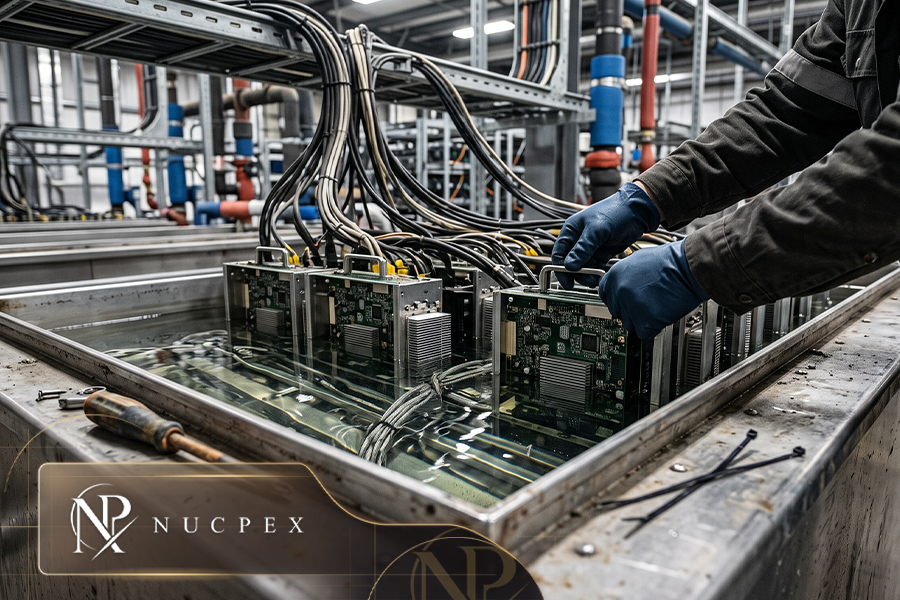
Cryptocurrency mining is often described as creating digital coins using powerful computers. Although that description captures part of the process, mining performs a more important function: helping decentralized blockchain networks agree on valid transactions without relying on a central authority.
Bitcoin mining, for example, combines specialized hardware, cryptographic calculations, and economic incentives to protect a public transaction record. However, not every cryptocurrency can be mined, and operating mining equipment does not guarantee profits.
This guide explains how crypto mining works, what equipment miners use, how rewards are earned, and whether mining can still be economically viable in 2026.
What Is Crypto Mining?
Crypto mining is the process of using computational resources to compete for the right to add new blocks to certain blockchain networks. It is primarily associated with cryptocurrencies that use a consensus mechanism called Proof of Work (PoW).
Successful miners may receive newly issued cryptocurrency and transaction fees. Their computational work also makes rewriting confirmed blockchain history increasingly difficult.
Mining should not be confused with ordinary transaction verification. Full nodes independently check blockchain rules, while miners compete to produce valid blocks. Both contribute to network operation, but their responsibilities differ.
How Does Crypto Mining Work?
In a Proof-of-Work network, miners repeatedly calculate cryptographic hashes while searching for a block header that meets the network’s difficulty target. The process involves enormous numbers of attempts rather than solving a conventional mathematical equation.
Bitcoin’s protocol adjusts mining difficulty periodically to maintain an average block interval of approximately ten minutes.
Step 1: Transactions Enter the Network
When someone sends Bitcoin, the transaction is broadcast to the network. Nodes examine whether it follows the protocol’s rules, including valid authorization and whether the referenced funds are available.
Valid unconfirmed transactions may remain in a node’s memory pool until a miner selects them for inclusion in a block.
Step 2: Miners Build Candidate Blocks
Mining software assembles eligible transactions into a proposed block. It also includes a special coinbase transaction that specifies the block subsidy and eligible transaction fees.
The block header contains information linking it to the previous block, along with a commitment to the selected transactions.
Step 3: Mining Hardware Searches for a Valid Hash
Mining devices repeatedly modify available block-header inputs and calculate hashes. For Bitcoin, the hashing process uses SHA-256 twice.
A miner succeeds when the resulting hash is below the network’s target threshold. More computing power increases the probability of finding a valid block, but it does not guarantee when success will occur.
Step 4: Nodes Verify the Winning Block
The successful miner broadcasts its proposed block. Other nodes independently verify its Proof of Work, transactions, and compliance with consensus rules.
If accepted, the block extends the blockchain. Competing blocks can occasionally appear, so additional confirmations reduce the probability of a transaction being reversed.
Why Is Crypto Mining Important?
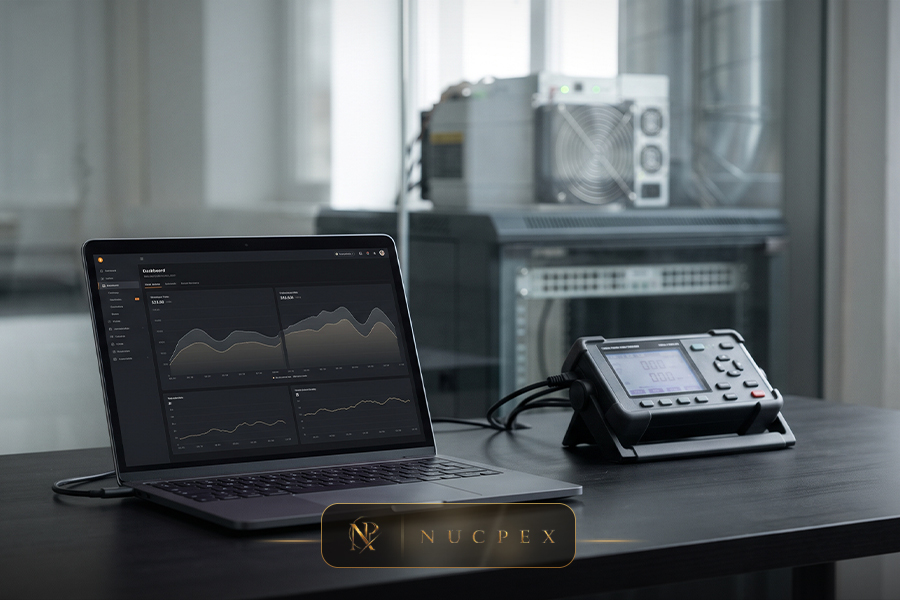
Mining supports transaction ordering and makes attacks on Proof-of-Work networks economically expensive. Altering historical blocks would require rebuilding the relevant computational work and competing against the network.
Mining also distributes new coins according to predetermined protocol rules rather than discretionary decisions by a central institution.
Its security benefits depend on several conditions, including network participation, mining concentration, economic incentives, and the cost of obtaining sufficient computing power.
What Equipment Is Needed for Crypto Mining?
Mining hardware depends on the cryptocurrency’s algorithm. Equipment suitable for one network may be ineffective or incompatible with another.
Modern Bitcoin mining relies heavily on application-specific integrated circuits (ASICs), designed to perform a particular hashing operation efficiently.
Common equipment and infrastructure include:
- ASIC Miners: Specialized machines for compatible mining algorithms;
- GPU Systems: Graphics processors used by some mineable networks;
- Power Supply: Reliable electricity and suitable electrical infrastructure;
- Cooling Systems: Ventilation or other heat-management arrangements;
- Mining Software: Programs that coordinate hardware and mining work.
Hardware purchase price alone is insufficient for assessing feasibility. Noise, cooling requirements, electrical safety, and equipment depreciation can materially affect total costs.
How Do Crypto Miners Earn Money?
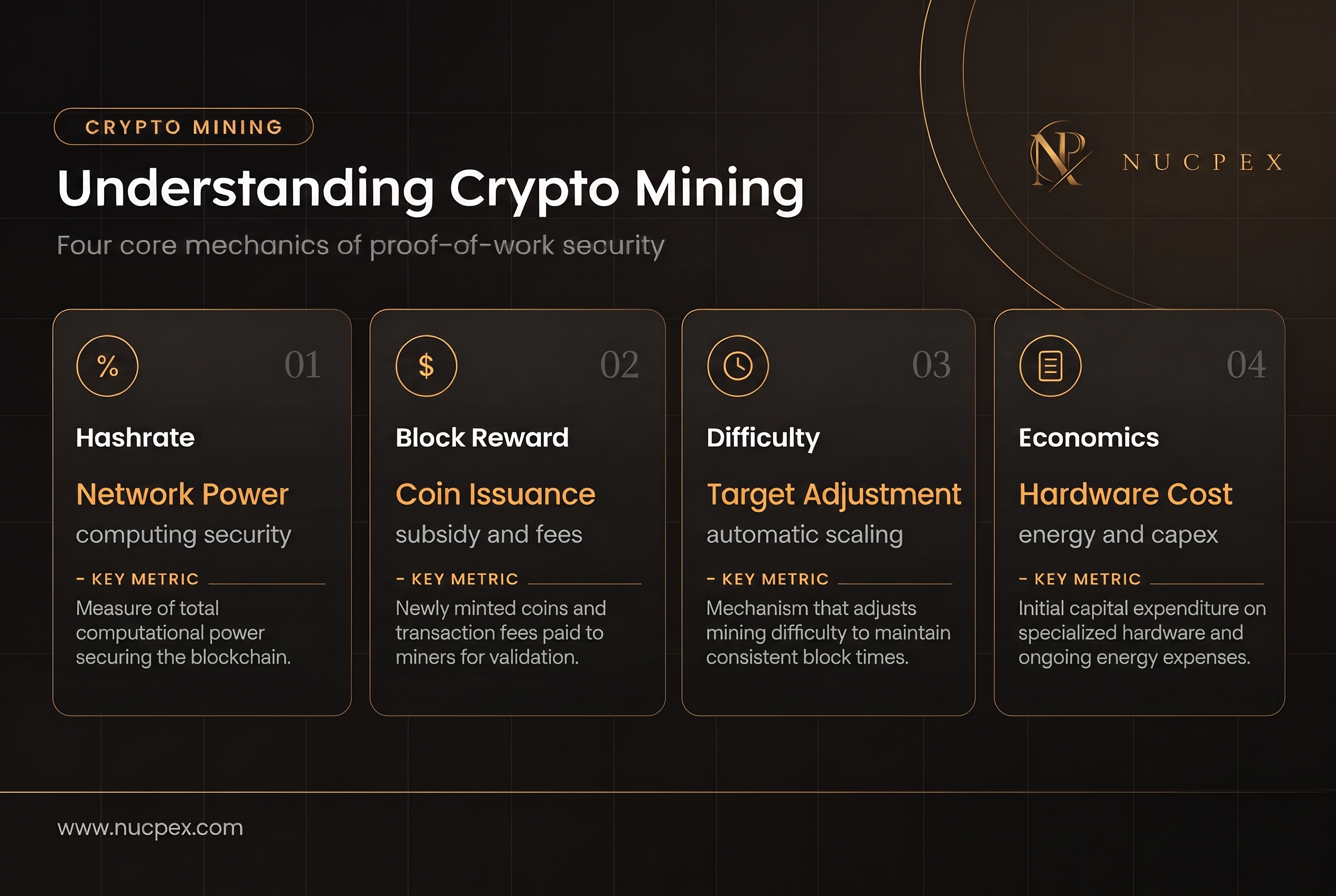
Mining revenue generally comes from two sources: newly issued coins and transaction fees. The amount earned depends on the network’s reward rules and whether a miner successfully contributes to accepted blocks.
For Bitcoin, the current block subsidy is 3.125 BTC, following the April 2024 halving. A successful block producer can also collect the transaction fees included in that block.
Solo Mining vs. Mining Pools
Solo miners compete independently and receive the full eligible block reward if they discover an accepted block. However, payouts can be extremely infrequent, especially for operators with limited computing power.
Mining pools combine participants’ computational resources and distribute earnings according to their payout rules. Pool participation can reduce payment variability but introduces fees and dependence on the pool operator.
Is Crypto Mining Profitable in 2026?
Mining profitability depends on cryptocurrency prices, network difficulty, electricity costs, hardware efficiency, and operating expenses. A profitable operation under one set of conditions can become unprofitable when those conditions change.
Consider a hypothetical mining device consuming 3,000 watts continuously. At an electricity price of $0.10 per kilowatt-hour, its daily energy cost would be:
3 kW × 24 hours × $0.10 = $7.20 per day
That equals approximately $216 over 30 days, excluding cooling, maintenance, equipment depreciation, and other expenses.
To calculate profitability, expected mining revenue must exceed the full cost of operation. Actual earnings also depend on network competition and the miner’s effective hashrate.
Why the Bitcoin Halving Matters
Bitcoin’s block subsidy is reduced by half approximately every 210,000 blocks. The April 2024 halving lowered it from 6.25 BTC to 3.125 BTC.
The next halving is expected around 2028, when the subsidy is scheduled to decrease to 1.5625 BTC. Halving reduces newly issued Bitcoin per block but does not guarantee higher market prices.
Crypto Mining vs. Staking: What’s the Difference?
Mining and staking are different approaches to blockchain consensus. Proof of Work relies on computational competition, while Proof of Stake relies on validators committing eligible cryptocurrency under network-specific rules.
Ethereum permanently ended mining when it transitioned to Proof of Stake in September 2022. ETH is therefore no longer mineable on Ethereum Mainnet.
| Feature | Crypto Mining | Crypto Staking |
| Consensus | Proof of Work | Proof of Stake |
| Main Resource | Computing Power | Staked Assets |
| Typical Costs | Hardware and Electricity | Capital and Infrastructure |
| Main Risks | Energy and Equipment Costs | Slashing and Token Risk |
| Example | Bitcoin | Ethereum |
Staking does not eliminate financial risk, and its reward arrangements vary significantly between networks and providers. If you need more information about crypto investing, do not hesitate to contact us.
Environmental Impact of Crypto Mining
Proof-of-Work mining consumes electricity because computational competition is central to its security model. Its environmental impact depends on energy sources, equipment efficiency, grid conditions, and operating practices.
The Cambridge Centre for Alternative Finance’s 2025 Digital Mining Industry Report estimated Bitcoin’s annual electricity consumption at 138 terawatt-hours, approximately 0.5% of global electricity usage at the time studied.
The report estimated that sustainable energy sources accounted for 52.4% of the surveyed mining energy mix, including renewables and nuclear power. These are research estimates, not live measurements for October 2026.
Risks of Crypto Mining and Cloud Mining
Mining introduces business, technical, and financial risks beyond fluctuations in cryptocurrency prices. Operators can lose money even while producing digital assets.
Key risks include:
- Price Declines: Falling coin values reduce revenue;
- Difficulty Changes: More network competition reduces expected output;
- Hardware Depreciation: Equipment can become economically obsolete;
- Regulatory Restrictions: Local rules may limit mining activities;
- Cloud Mining Fraud: Unverifiable contracts may conceal scams or excessive fees.
Cloud mining services should be assessed carefully. Promises of guaranteed daily returns, unverifiable facilities, or unusually high payouts are warning signs rather than evidence of profitability.
Final Thoughts
Crypto mining is an essential component of Proof-of-Work blockchains, combining computational effort, transaction processing, and financial incentives to maintain decentralized networks.
Understanding mining requires more than knowing how coins are created. Hardware efficiency, electricity prices, mining difficulty, reward schedules, and operational risks all influence outcomes.
For beginners, learning how mining economics work is more valuable than assuming that owning mining equipment automatically generates income.
At NUCPEX, we emphasize informed financial decisions, transparent analysis, and a realistic understanding of investment risks.
Disclaimer: This article is intended for general educational purposes and does not constitute personalized investment advice. Cryptocurrency mining and related investments involve financial, operational, and regulatory risks.
Frequently Asked Questions
Can I mine Bitcoin using my smartphone?
A smartphone can perform calculations, but it cannot realistically compete with modern Bitcoin ASIC equipment. Apps promising substantial smartphone mining income should be treated cautiously.
How long does it take to mine one Bitcoin?
There is no fixed time for an individual miner. Rewards depend on computing power, network difficulty, luck, and pool participation rather than a predictable one-Bitcoin production schedule.
Do Bitcoin miners need an internet connection?
Yes. Miners need network connectivity to receive mining work and communicate valid blocks or shares. Connection reliability can affect effective mining performance.
What happens when all Bitcoin has been mined?
Bitcoin’s subsidy is expected to decline toward zero around 2140. Mining can continue afterward, with transaction fees providing the remaining direct block-production incentive.
Is crypto mining legal everywhere?
No. Rules differ by jurisdiction and may involve licensing, electricity use, taxation, and restrictions on digital assets. Operators should check current local requirements before purchasing equipment.
No Comments Yet