
10 Long-Term Investing Tips to Build Wealth

Building wealth through investing rarely depends on a single successful trade. More often, it requires consistent decisions, a realistic financial plan, and the discipline to remain focused when markets become unpredictable.
Long-term investing involves holding suitable investments over an extended period, typically several years or decades, to pursue financial goals. While a longer investment horizon can provide more time to recover from temporary market declines, it does not eliminate the possibility of losses.
The most useful long-term investing tips focus on factors investors can control: contributions, diversification, costs, risk exposure, and investment behavior.
This guide explores ten practical principles for developing a sustainable investment approach, supported by examples and considerations for beginners and experienced investors alike.
What Is Long-Term Investing?
Long-term investing is an approach in which investors hold assets over several years, often to support objectives such as retirement, education, or financial independence.
Unlike short-term trading, which focuses on relatively immediate price movements, long-term investing emphasizes the potential accumulation of value over time. Investment returns may come from capital appreciation, dividends, interest, or a combination of these sources.
However, holding an asset for many years does not automatically make it a good investment. Asset quality, valuation, diversification, and financial suitability still matter.

Why Is Long-Term Investing Important?
Time can be a valuable component of an investment strategy because it allows returns to accumulate and, when reinvested, potentially generate additional returns.
A longer horizon may also reduce the need to make decisions based on short-term market movements. Nevertheless, markets can experience prolonged downturns, and even long holding periods do not guarantee positive results.
Successful long-term investing therefore depends on combining patience with appropriate risk management rather than relying on time alone.
10 Essential Long-Term Investing Tips
The following ten principles provide a framework for approaching long-term investment decisions. They are relevant across different asset classes, although their practical application depends on individual circumstances.
1. Set Specific Long-Term Financial Goals
Investing becomes more purposeful when every major decision supports a defined objective. Saving for retirement in 25 years requires a different approach from accumulating funds for a property purchase in five years.
Translate broad ambitions into measurable targets, including the amount needed, the intended date, and the contributions you can reasonably afford.
For example, an investor seeking to accumulate AED 300,000 over 15 years can estimate the monthly savings required under different return assumptions. Because actual returns are uncertain, the plan should also consider scenarios in which markets perform poorly.
2. Start Early and Understand Compounding
Compounding occurs when investment earnings remain invested and subsequently generate additional earnings. Over extended periods, this process can meaningfully influence portfolio growth.
For example, a hypothetical AED 10,000 investment earning a constant 6% annually would grow to approximately AED 32,071 after 20 years, before fees, taxes, and inflation.
The same investment would reach approximately AED 57,435 after 30 years under identical assumptions.
These are mathematical illustrations, not forecasts. Actual investment returns fluctuate, and losses can interrupt or reverse accumulated growth.
3. Invest Consistently Instead of Trying to Predict Every Market Move
Market timing requires correctly anticipating both when to leave the market and when to return. Making these decisions consistently is difficult, even for experienced investors.
Regular investing provides a structured alternative. A fixed monthly contribution can reduce dependence on choosing one ideal entry point and help investors maintain discipline.
This approach is commonly known as dollar-cost averaging. It does not guarantee profits or eliminate losses, and spreading an available lump sum over time can sometimes produce lower returns than investing immediately.
Its main practical advantage is helping investors follow a contribution schedule that fits their financial circumstances.
4. Diversify Across Assets, Sectors, and Markets
Diversification reduces dependence on the performance of a single investment, company, industry, or geographic market.
A portfolio concentrated entirely in one technology company may perform exceptionally well during favorable conditions but face substantial losses if that company’s prospects deteriorate.
Investors can evaluate diversification across several dimensions:
- Asset Classes: Equities, bonds, and appropriate cash holdings;
- Industries: Technology, healthcare, financial services, and other sectors;
- Geographies: Domestic and international markets;
- Issuers: Multiple companies or bond issuers;
- Investment Vehicles: Diversified funds where suitable.
Diversification does not prevent losses during broad market declines. Its purpose is to manage concentration rather than guarantee returns.
5. Match Your Investment Risk to Your Time Horizon
Long-term investors may be able to tolerate greater short-term volatility, but investment horizon is only one consideration.
Risk capacity depends on financial stability, future spending needs, debt obligations, and the ability to absorb losses. Risk tolerance describes the emotional willingness to accept fluctuations.
For example, two investors may both have a 20-year horizon but require different portfolios because one has stable income and substantial savings while the other has uncertain employment and significant financial commitments.
An appropriate strategy should reflect both the willingness and financial ability to take risk.
6. Keep Investment Fees and Taxes Under Control
Investment expenses reduce the returns investors retain. Their effect can become substantial when costs accumulate over many years.
Investors should evaluate fund expenses, brokerage commissions, spreads, custody fees, and currency conversion costs. Applicable taxes also depend on residency, investment structure, and relevant jurisdictions.
Want to know more, Contact us!
7. Reinvest Returns When They Are Not Needed for Income
Dividends and interest can support long-term growth when reinvested rather than withdrawn for spending.
For example, reinvested distributions may purchase additional fund units or securities, increasing the amount of capital exposed to future market returns.
However, reinvestment is not always appropriate. Investors who need regular income may reasonably choose to receive distributions in cash.
Reinvestment can also create tax consequences, and distributions are not guaranteed. The decision should reflect cash-flow requirements and the investment’s underlying characteristics.
8. Avoid Emotional Decisions During Market Volatility
Financial markets respond to economic data, monetary policy, geopolitical developments, and changing expectations. Price declines can create pressure to sell, while strong rallies may encourage investors to chase recent winners.
Neither reaction necessarily supports long-term objectives.
A written investment policy can help establish when a portfolio change is justified. It should distinguish changes in personal circumstances or investment fundamentals from ordinary market fluctuations.
Long-term discipline does not mean refusing to sell a deteriorating investment. It means making decisions based on evidence and strategy rather than fear or excitement alone.
9. Review and Rebalance Your Portfolio Periodically
Different assets grow or decline at different rates. Over time, this changes their proportions within a portfolio and may increase exposure to risks the investor did not originally intend.
Rebalancing involves reviewing current allocations and, when appropriate, restoring them toward target weights.
For example, a portfolio initially allocated 60% to equities and 40% to bonds may become 70% equities after a period of stronger stock-market performance.
An investor might consider rebalancing through new contributions or transactions, subject to costs and tax consequences.
The objective is to maintain an appropriate risk profile, not to guarantee higher investment returns.
10. Protect Your Financial Foundation and Avoid Unnecessary Leverage
Long-term investing is difficult to sustain when unexpected expenses force an investor to sell assets at unfavorable prices.
Maintaining appropriate emergency savings, managing expensive debt, and protecting essential financial obligations can reduce the likelihood of forced investment withdrawals.
Leverage deserves particular caution because borrowed funds amplify gains and losses. Margin requirements may force positions to close even when an investor originally intended to hold them for years.
Investors should also verify financial service providers, understand custody arrangements, and remain skeptical of promises of guaranteed high returns.
Long-Term Investing vs. Short-Term Trading
Long-term investing and short-term trading involve different objectives, time commitments, and risk considerations.
Neither approach guarantees profits, but they generally require different analytical frameworks.
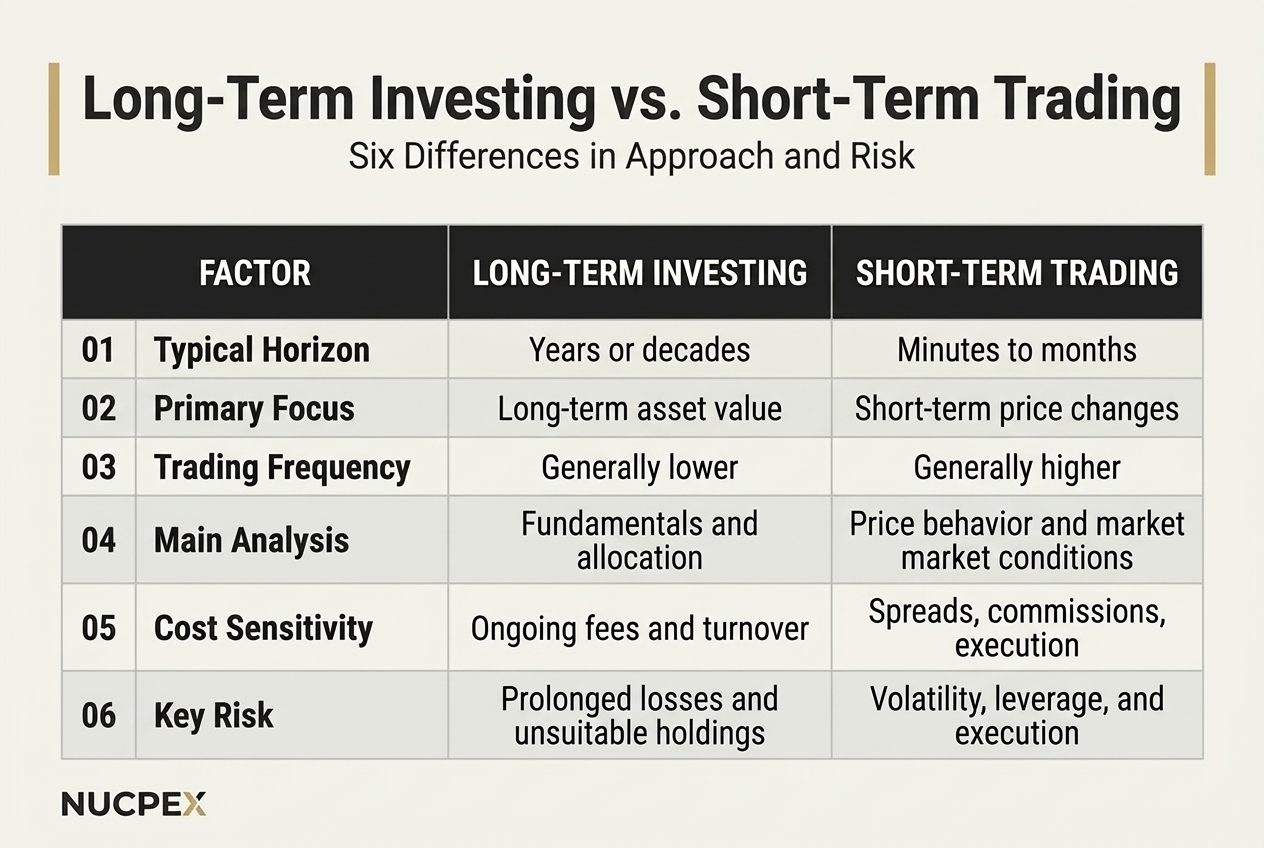
A long-term investor should still monitor risks and changing circumstances. Lower trading frequency does not mean that portfolio oversight is unnecessary.
Common Long-Term Investing Mistakes to Avoid
Even a sound investment strategy can be undermined by inconsistent behavior or unrealistic expectations.
Investors should watch for several recurring mistakes:
- Concentrating too much capital in a single investment;
- Chasing assets after unusually strong recent performance;
- Assuming long-term holding guarantees a recovery;
- Ignoring inflation, fees, and currency exposure;
- Taking excessive risk to compensate for starting late;
- Changing strategies in response to every market headline;
- Using leverage without understanding margin and liquidation risks.
Avoiding these mistakes does not ensure investment success, but it can improve the consistency and clarity of financial decision-making.
A Practical Long-Term Investing Checklist
A simple review process can help translate general principles into repeatable decisions.
Before investing or making a significant portfolio change, consider:
- Purpose: Does the investment support a defined financial goal;
- Horizon: Can the money remain invested for the required period;
- Risk: Can potential losses be absorbed without financial distress;
- Diversification: Does the position create excessive concentration;
- Costs: Are fees and relevant tax implications understood;
- Liquidity: Can the investment be sold when funds are needed;
- Discipline: Is the decision based on a documented strategy.
Revisit these questions when personal circumstances or investment fundamentals change.
Final Thoughts
Long-term investing is not about identifying one perfect investment or accurately predicting every market movement. It is about making a series of informed decisions that remain aligned with financial objectives over time.
Clear goals, consistent contributions, diversification, cost control, and realistic risk management provide a stronger foundation than speculation or short-term market predictions.
The most valuable long-term investing strategy is one that an investor can understand, maintain, and adjust responsibly as circumstances evolve.
At NUCPEX, we emphasize informed financial decisions, disciplined market analysis, and a realistic assessment of investment risks and opportunities.
Disclaimer: This article is provided for general financial education and does not constitute personalized investment advice. Investment values can rise or fall, and past performance does not guarantee future results.
Frequently Asked Questions
1. How many years are considered long-term investing?
Long-term investing generally refers to holding assets for several years, often ten years or more. The appropriate horizon depends on the financial goal and the risks of the investment.
2. What is the best investment for long-term growth?
There is no universally best investment. Suitable choices depend on objectives, risk capacity, diversification, costs, and when the investor expects to need the money.
3. Should I keep investing when the market falls?
That depends on financial circumstances, investment suitability, and risk capacity. A disciplined contribution strategy may continue through volatility, but no approach guarantees recovery.
4. Is long-term investing safer than short-term trading?
Longer holding periods may reduce the need for frequent trading decisions, but they do not eliminate market risk. Individual investments can still experience prolonged or permanent losses.
5. How often should I review long-term investments?
An annual review may be a useful starting point. Significant changes in income, goals, investment fundamentals, or portfolio risk may justify earlier reassessment.



No Comments Yet