
What Is Forex and How Does the Forex Market Work?
Every time a business pays an overseas supplier or a traveler exchanges money before a trip, foreign exchange plays a role. The same global currency market also attracts banks, institutional investors, and individuals seeking opportunities from changing exchange rates.
But what is forex, and how does the forex market work? Understanding the answer requires more than learning how to buy and sell currencies. It also involves knowing who determines prices, why exchange rates fluctuate, and how trading costs and leverage affect financial outcomes.
This beginner-friendly guide explains the forex market, its participants, trading mechanisms, and risks using practical examples and current market data.
What Is Forex Market?
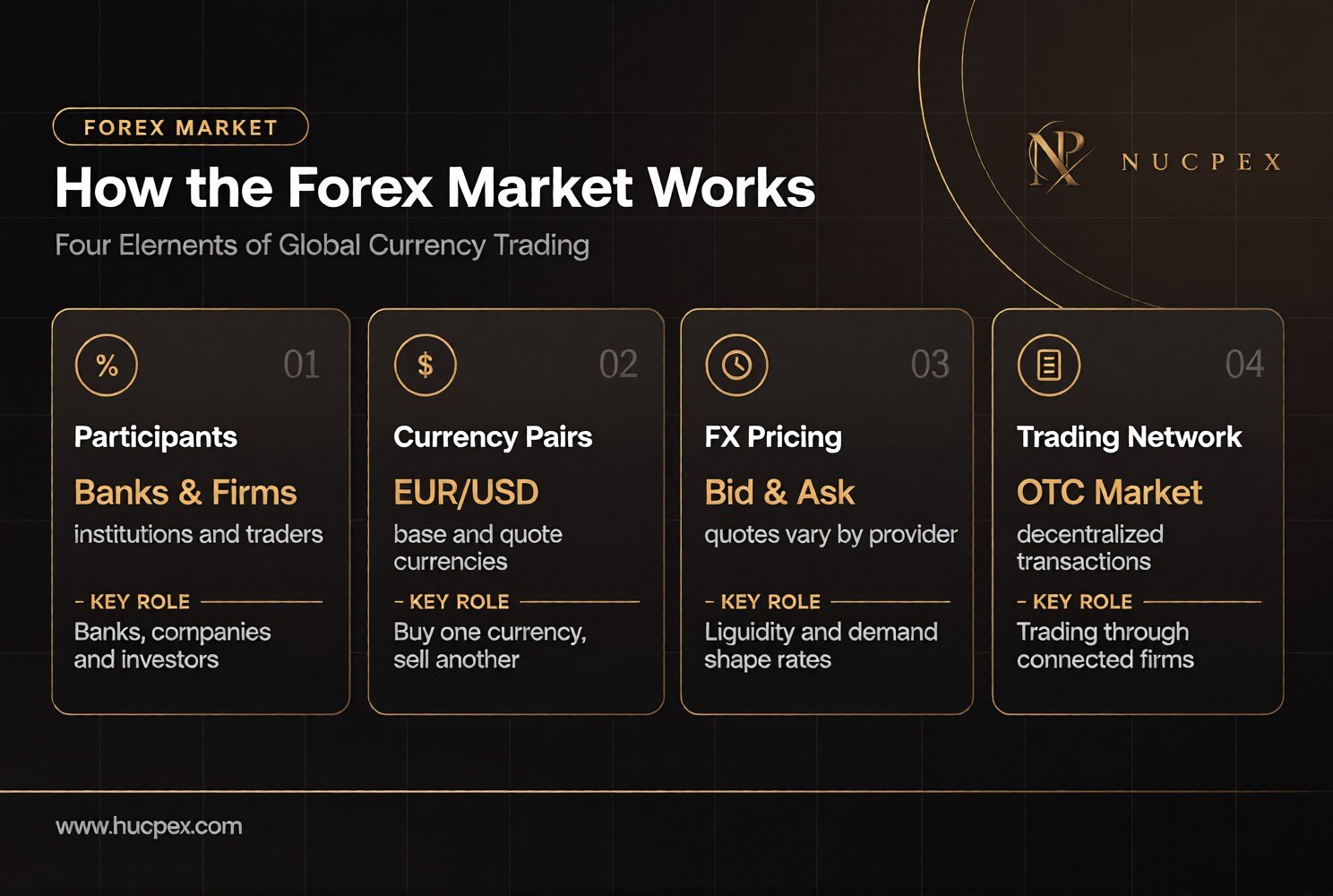
Forex, short for foreign exchange and commonly called FX, refers to the exchange of one currency for another. The forex market is the global network through which currencies are bought, sold, and exchanged.
Unlike a traditional stock exchange, most foreign exchange activity takes place through decentralized over-the-counter (OTC) markets. Banks, financial institutions, companies, and other participants negotiate transactions through interconnected trading systems.
According to the Bank for International Settlements (BIS), average global FX turnover reached $9.6 trillion per day in April 2025, up from approximately $7.5 trillion in April 2022. This includes spot transactions and several types of foreign exchange derivatives.
How Does the Forex Market Work?
Forex trading involves two currencies because an exchange rate expresses the value of one currency relative to another. Buying one currency necessarily involves selling another, whether the transaction is for international business or market speculation.
Currency prices are influenced by transactions across banks, liquidity providers, institutional platforms, and retail intermediaries. There is no single worldwide exchange that determines every forex quotation.
Understanding Currency Pairs
Currencies are quoted in pairs such as EUR/USD, GBP/USD, and USD/JPY. The first currency is the base currency, while the second is the quote currency.
For example, a hypothetical EUR/USD exchange rate of 1.1000 means one euro is worth 1.10 U.S. dollars. If the rate increases to 1.1100, the euro has strengthened relative to the dollar.
Currency pairs are commonly grouped into:
- Major Pairs: Widely traded pairs involving the U.S. dollar;
- Cross Pairs: Currency pairs that exclude the U.S. dollar;
- Exotic Pairs: Combinations involving a major and a less frequently traded currency.
These classifications help describe typical trading characteristics, but spreads and liquidity vary across providers and market conditions.
How Buying and Selling Forex Works
A trader who expects the euro to strengthen against the U.S. dollar might buy EUR/USD. Someone expecting the euro to weaken could take a short position through an appropriate trading instrument.
Consider a hypothetical purchase of 10,000 euros at EUR/USD 1.1000. If the exchange rate rises to 1.1050, the position’s value increases by $50 before trading costs.
If the rate instead falls to 1.0950, the position loses $50 before costs. The calculation assumes a linear spot-style exposure and excludes financing, commissions, and other charges.
Who Participates in the Forex Market?
The foreign exchange market serves many purposes beyond short-term speculation. International businesses need currencies for payments, while institutions manage exposures arising from investments and commercial activities.
Different participants have different objectives, transaction sizes, and access to liquidity.
Major participants include:
- Commercial Banks: Provide currency liquidity and execute transactions;
- Central Banks: Implement monetary policy and may intervene in currency markets;
- Corporations: Exchange currencies and hedge international payment risks;
- Institutional Investors: Manage foreign-currency portfolio exposure;
- Retail Traders: Speculate through brokers or other authorized providers.
Retail forex platforms do not necessarily provide direct access to institutional interbank trading. The legal relationship between a customer and their provider depends on the product and jurisdiction.
What Moves Forex Exchange Rates?
Exchange rates respond to changing expectations about economic conditions, monetary policy, and demand for currencies. Because prices are relative, developments affecting either currency can influence the pair.
Economic announcements can cause sharp movements, but market reactions depend on whether new information differs from previous expectations.
Important drivers include:
- Interest Rates: Affect the relative attractiveness of currency-denominated assets;
- Inflation: Influences purchasing power and monetary policy expectations;
- Economic Growth: Changes expectations about investment and demand;
- Geopolitical Events: Increase uncertainty and alter capital flows;
- Market Sentiment: Influences demand for perceived defensive or higher-risk currencies.
Higher interest rates do not automatically make a currency appreciate. Expected policy changes, inflation, and broader economic conditions also matter.
When Is the Forex Market Open?
The global forex market generally operates 24 hours a day, five days a week. Trading moves across major financial centers as business hours overlap between regions.
Activity is commonly discussed in terms of Sydney, Tokyo, London, and New York sessions. Exact opening and closing times can shift with daylight saving time and individual trading venues.
Liquidity often increases when major sessions overlap, particularly London and New York. However, high trading activity does not eliminate volatility, slippage, or execution risk.
Key Forex Trading Terms Beginners Should Know
Forex quotations and trading platforms use terminology that can be confusing to new participants. Understanding these terms is essential for evaluating costs and position exposure.
A trader should be able to calculate the approximate financial effect of a price movement before opening a position.
Pips, Lots, and Spreads
A pip is a conventional unit used to measure changes in exchange rates. For most currency pairs, one pip equals 0.0001; for many yen-quoted pairs, it equals 0.01.
A standard lot generally represents 100,000 units of the base currency, while smaller position sizes may be available.
The spread is the difference between the quoted buying and selling prices. It represents an important transaction cost, particularly for frequent traders.
Leverage and Margin
Leverage allows traders to control a larger market position with a smaller amount of deposited capital. Margin is the collateral required to establish or maintain that exposure.
For example, a 20:1 leverage ratio could allow a $1,000 margin deposit to support a $20,000 position, subject to the provider’s requirements.
A 1% adverse movement on that $20,000 exposure would represent approximately a $200 loss before costs—equivalent to 20% of the initial $1,000 margin. Losses may exceed the initial deposit where negative balance protection does not apply.
Spot Forex, Forwards, Futures, and CFDs
Not every forex transaction uses the same financial instrument. Spot transactions, forwards, futures, and contracts for difference (CFDs) have distinct settlement, pricing, and regulatory characteristics.
Understanding the instrument matters because trading a derivative is not necessarily equivalent to owning and receiving the underlying currency.
| Instrument | Primary Characteristic | Common Purpose |
| Spot FX | Currency exchange at prevailing rates | Payments and trading |
| FX Forward | Agreed exchange at a future date | Currency hedging |
| FX Future | Standardized exchange-traded contract | Hedging and speculation |
| Forex CFD | Cash-settled price exposure | Leveraged speculation |
CFDs are restricted or prohibited for certain retail investors in some jurisdictions. Product availability and investor protections should be verified locally.
What Are the Main Risks of Forex Trading?
Forex is highly liquid at the global level, but that does not make individual trades safe. Retail participants can face substantial losses, especially when using leverage.
The U.S. Commodity Futures Trading Commission warns that most customers trading OTC forex lose money after relevant costs. It also highlights risks associated with dealer-controlled platforms and fraudulent providers.
Important risks include:
- Leverage Risk: Small market movements can produce large losses;
- Exchange-Rate Risk: Currency prices can change unexpectedly;
- Execution Risk: Slippage and widening spreads affect trade outcomes;
- Counterparty Risk: OTC trading creates exposure to intermediaries;
- Fraud Risk: Unauthorized providers may misuse customer funds.
A stop-loss order can help define intended risk, but it cannot guarantee execution at the requested price.
How Can Beginners Learn Forex Trading Safely?
Learning the fundamentals should come before using real capital. Beginners benefit from understanding currency quotations, economic calendars, order execution, and the specific contracts offered by brokers.
A structured learning process includes:
- Study currency pairs, pips, spreads, and leverage;
- Verify a broker’s regulatory authorization;
- Compare product terms and total trading costs;
- Practice order placement through a demo account;
- Develop written risk limits before considering live trading.
A demo account can help users understand platform mechanics, but simulated performance does not reliably predict real-money results.
Final Thoughts
Understanding what forex is and how the forex market works provides a foundation for evaluating currency-related opportunities and risks.
The forex market supports international commerce, investment flows, and risk management. Its decentralized structure and continuous global activity also create complexities that are easy to overlook when focusing only on price charts.
For beginners, the most important distinction is between understanding currency exchange and taking leveraged speculative positions. Market knowledge, transparent costs, and careful risk assessment should come before any trading decision.
At NUCPEX, we emphasize financial education, informed analysis, and responsible decision-making based on realistic expectations.
Disclaimer: This article provides general financial education and does not constitute personalized investment advice. Forex trading involves substantial risk, particularly when leverage is used.
Frequently Asked Questions
1. Does the forex market have a single regulator?
No. Forex activity spans multiple jurisdictions, each with its own regulatory framework. Oversight depends on the financial institution, product, and location.
2. Can I trade forex without leverage?
Yes, depending on the provider and instrument. Investors can exchange currencies without borrowing, although some retail trading platforms primarily offer leveraged products.
3. Is the forex market open on weekends?
Most conventional forex trading closes over the weekend. Some providers offer limited weekend products, but these may have different pricing and liquidity conditions.
4. Can forex prices differ between brokers?
Yes. Forex is decentralized, and providers may use different liquidity sources, markups, and pricing arrangements. Bid and ask quotations can therefore vary between platforms.
5. Is forex trading the same as exchanging money at a bank?
Both involve foreign currencies, but bank currency conversion generally serves a payment or travel purpose. Retail forex trading often involves speculative positions, derivatives, and leverage.
No Comments Yet