
3 Superior Cryptocurrencies to Buy and Hold for 10 Years
The cryptocurrency market offers thousands of digital assets, but relatively few have a credible case for remaining relevant through 2036. Choosing the best cryptocurrencies to buy and hold for 10 years requires more than following price momentum or short-term predictions.
Bitcoin (BTC), Ethereum (ETH), and Solana (SOL) stand out for different reasons: Bitcoin’s scarcity, Ethereum’s programmable financial infrastructure, and Solana’s focus on fast, low-cost transactions. Each also faces significant risks that could undermine its long-term investment case.
This analysis examines their fundamentals, recent developments, and the conditions that could determine whether they remain competitive over the next decade.
Cryptocurrency Market Outlook: October 2026
Crypto markets remain sensitive to interest-rate expectations, institutional investment flows, and global risk appetite. Wider access through exchange-traded products has expanded participation, but institutional adoption does not guarantee rising prices.
Recent market commentary highlights this uncertainty. In October, Bitcoin showed relative price resilience despite reported ETF outflows. Analysts cautioned that a sustained recovery would require stronger underlying demand rather than temporary price stability.
According to CoinGecko’s historical data, the following were the recorded USD closing prices on October 27, 2026:
| Cryptocurrency | Closing Price |
| Bitcoin (BTC) | $80,572 |
| Ethereum (ETH) | $2,346.99 |
| Solana (SOL) | $101.03 |
These are historical closing prices, not live quotations. Prices can change substantially between publication and the time an investor makes a decision.
-
Bitcoin (BTC): The Strongest Scarcity-Based Investment Case
Bitcoin remains the most established cryptocurrency by market capitalization and institutional recognition. Its principal investment proposition is straightforward: a decentralized monetary network with a maximum supply of approximately 21 million BTC.
Unlike cryptocurrencies designed to support complex applications, Bitcoin focuses primarily on transferring and holding value without relying on a central issuing authority.
Why Bitcoin Could Remain Relevant Through 2036
Bitcoin’s predictable issuance schedule is a defining characteristic. Mining rewards are reduced approximately every four years, gradually slowing the creation of new coins.
Further halvings are expected around 2028, 2032, and 2036. If demand remains strong, reduced new issuance could support scarcity-driven valuations. However, scarcity alone cannot create demand or guarantee appreciation.
The availability of regulated spot Bitcoin exchange-traded products in the United States also gives certain investors an alternative to holding cryptocurrency directly. This improves accessibility but does not eliminate Bitcoin’s underlying market risks.
What Could Weaken Bitcoin’s Long-Term Performance?
Bitcoin’s relatively mature market position does not make it a safe investment. Its valuation remains heavily influenced by expectations, liquidity, and investor confidence rather than conventional corporate earnings.
Long-term investors should monitor several vulnerabilities:
- Extended periods of declining demand or reduced institutional interest;
- Regulatory restrictions affecting trading, custody, or market access;
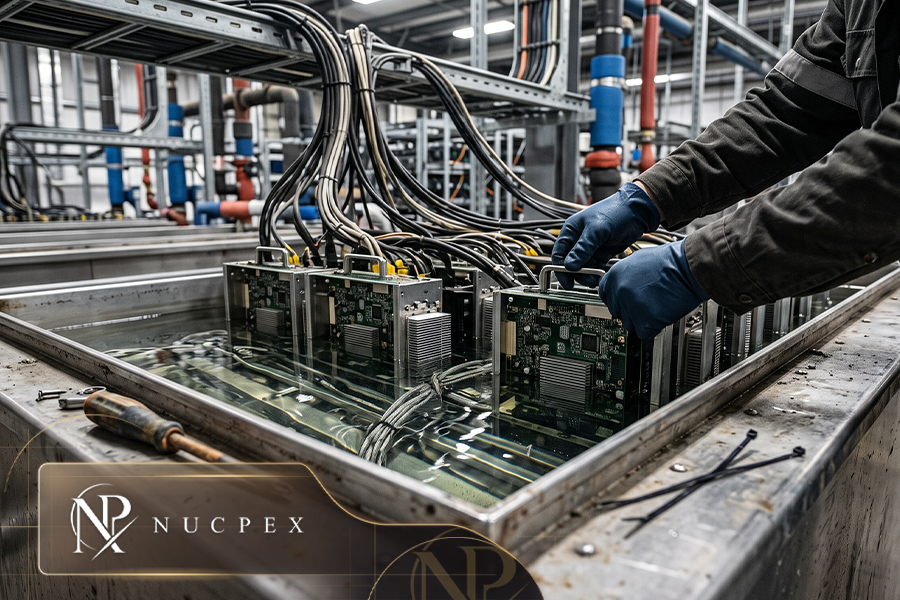
- Security and economic pressures on miners as block subsidies decline;
- Severe price drawdowns during periods of financial stress.
Bitcoin is the most defensible long-term candidate among these three in terms of established market position, but substantial losses remain possible.
-
Ethereum (ETH): A Foundation for On-Chain Finance
Ethereum offers a different investment thesis. Rather than focusing primarily on monetary scarcity, it provides infrastructure for smart contracts, decentralized applications, stablecoins, and tokenized financial assets.
Ether (ETH) is used to pay network transaction fees and support Ethereum’s proof-of-stake consensus mechanism. Its long-term prospects therefore depend partly on whether economic activity continues to develop around Ethereum’s ecosystem.
Why Ethereum’s Development Roadmap Matters
Ethereum’s strategy relies heavily on scaling technologies, including layer-2 networks that process transactions more efficiently while using Ethereum for settlement and security.
Its official development roadmap identifies Glamsterdam as a planned upgrade for late 2026. Proposed improvements aim to strengthen transaction processing and network efficiency, although delivery schedules and technical outcomes can change.
The growing interest in tokenizing traditional assets could also benefit Ethereum if financial institutions continue choosing its infrastructure. However, increased network activity does not automatically translate into proportional ETH price appreciation.
What Could Challenge Ethereum Over 10 Years?
Ethereum faces competition from alternative blockchains offering faster transactions or simpler user experiences. Its dependence on multiple scaling networks also introduces questions about liquidity fragmentation and how economic value reaches ETH holders.
Important risks include:
- Competing networks capturing developers, users, and financial applications;
- Lower transaction fees reducing the amount of ETH removed through fee burning;
- Smart-contract vulnerabilities and risks associated with third-party applications;
- Delayed upgrades or weaker-than-expected demand for tokenized assets.
Ethereum’s investment case is compelling because of its established ecosystem, but its future value depends on both technological adoption and sustainable token economics.
-
Solana (SOL): Higher-Growth Potential With Higher Execution Risk
Solana is designed to support applications requiring fast transactions and relatively low costs. Its architecture has attracted activity involving payments, decentralized exchanges, and consumer-facing blockchain services.
For investors considering a ten-year horizon, Solana represents a more aggressive thesis: that demand for efficient blockchain infrastructure will expand substantially and that Solana will capture a meaningful share.
Why Solana’s 2026 Upgrades Are Important
Solana’s development roadmap includes Alpenglow, a consensus upgrade targeting transaction finality of approximately 150 milliseconds. Faster finality could improve the experience of applications that depend on rapid settlement.
According to Solana Foundation documentation updated in October 2026, important validator prerequisites were already active, while the broader consensus transition was scheduled separately. The upgrade should therefore be treated as a developing technical milestone, not an already completed improvement.
If Solana continues attracting developers and meaningful economic activity, its infrastructure could become increasingly valuable. Nevertheless, technological progress does not establish a guaranteed return for SOL investors.
What Makes Solana the Riskiest of These Three?
Solana’s growth opportunities come with considerable uncertainty. Network reliability, validator economics, competition, and the sustainability of application demand will all influence its future.
Investors should monitor:
- Whether network upgrades improve reliability under sustained demand;
- Validator participation and the consequences of changing network requirements;
- Dependence on speculative trading rather than durable application usage;
- Token issuance, staking economics, and competition from other blockchains.
Solana may offer greater growth potential than more established assets, but that possibility comes with a higher risk of underperformance or permanent capital loss.
Bitcoin vs. Ethereum vs. Solana: Which Has the Best 10-Year Outlook?
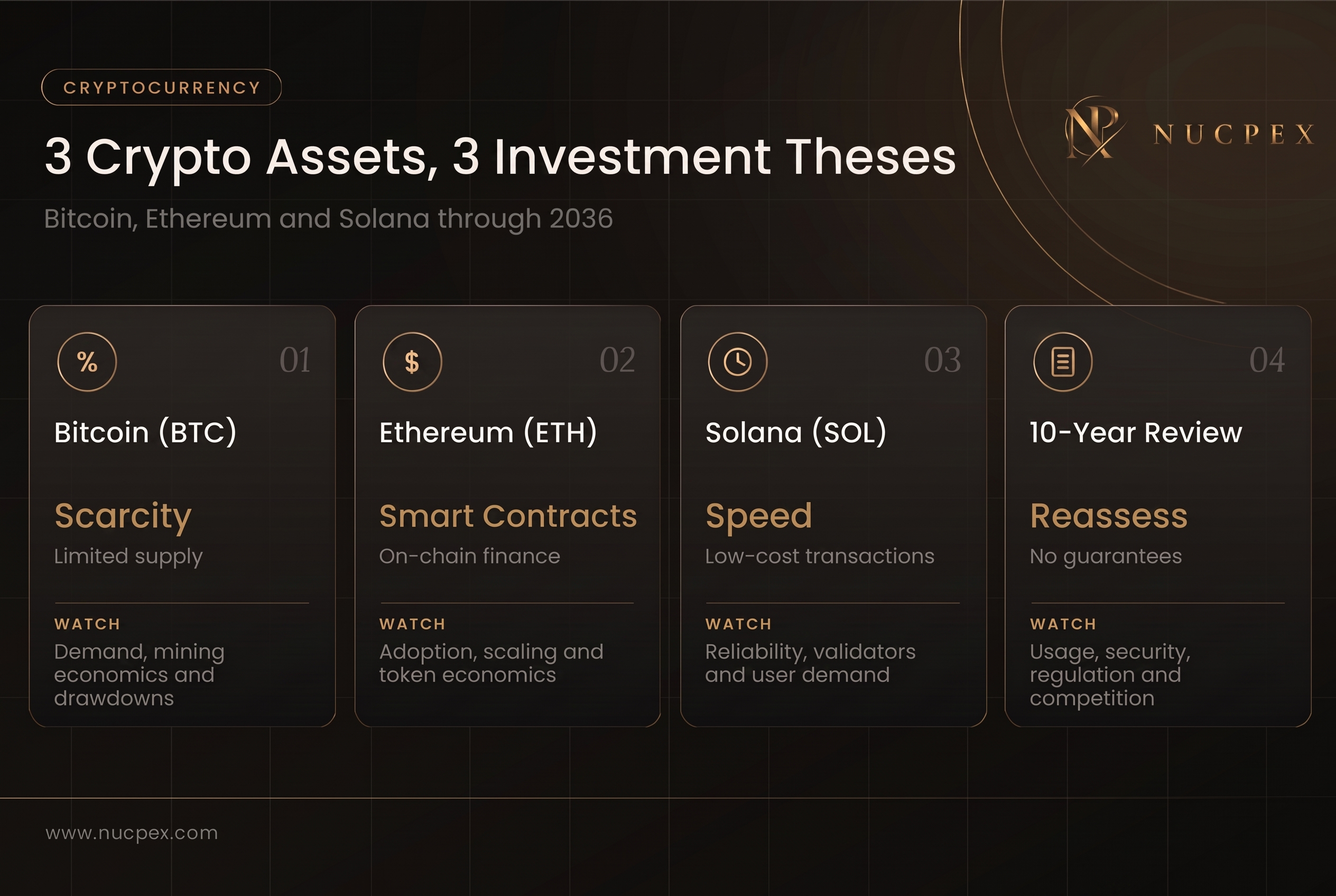
These cryptocurrencies should not be evaluated as interchangeable investments. Each depends on a different source of demand, and each could respond differently to changes in technology, regulation, or market conditions.
Bitcoin has the clearest scarcity-based investment thesis and the longest operating history. Ethereum offers exposure to programmable financial infrastructure, while Solana provides a more speculative opportunity tied to high-performance blockchain adoption.
For investors prioritizing relative resilience within cryptocurrency markets, Bitcoin has the strongest case. Ethereum offers a distinct infrastructure thesis, while Solana requires greater confidence in future execution and competitive positioning.
If you want to know more about cryptocurrencies, do not hesitate to contact us.
How to Evaluate a 10-Year Cryptocurrency Investment
A decade-long holding period does not remove the need for ongoing research. Blockchain technology, market structure, and regulation can change significantly before 2036.
Investors should periodically reassess whether the original investment thesis remains valid. Useful indicators include real network usage, developer activity, transaction economics, security, regulatory developments, and concentration of ownership.
Position sizing matters as much as asset selection. Cryptocurrency exposure should reflect an investor’s financial circumstances, liquidity requirements, and capacity to withstand substantial losses.
Final Thoughts
Bitcoin, Ethereum, and Solana represent three different approaches to the future of digital assets. Bitcoin emphasizes monetary scarcity, Ethereum supports programmable finance, and Solana competes through transaction performance.
None is guaranteed to deliver positive returns by 2036. Their success will depend on sustained adoption, resilient infrastructure, favorable economics, and the ability to adapt to changing markets.
At NUCPEX, we believe long-term investment decisions should be grounded in independent research, risk awareness, and clearly defined financial objectives. Explore our website to learn more about our financial consulting services.
Disclaimer: This article is for general information and market analysis only. It does not constitute personalized investment advice, an offer to sell, or a recommendation to purchase any digital asset. Cryptocurrency investments involve substantial risk, including the possible loss of all invested capital.
Frequently Asked Questions
1. Can cryptocurrency investments be inherited?.
Yes, but beneficiaries need a legally and technically workable way to access the assets. Estate planning should address private-key access, custody arrangements, and applicable inheritance laws.
2. Are cryptocurrency staking rewards guaranteed?
No. Staking rewards vary with network conditions and may be reduced by validator fees, penalties, or operational problems. Staking also introduces risks beyond changes in token prices.
3. Does holding cryptocurrency for 10 years change its tax treatment?
Tax obligations depend on the investor's jurisdiction and applicable rules. Holding periods may matter in some countries, while others apply different treatment to gains, staking income, or disposals.
4. What happens if a cryptocurrency blockchain splits into two networks?
A network split may create competing versions of a blockchain or token. Exchanges, custodians, and application providers may support different versions, creating uncertainty for holders.
5. Can a cryptocurrency disappear even after years of successful operation?
Yes. Declining adoption, security failures, regulatory changes, or economic problems can make a network or token commercially irrelevant, even after a long operating history.
No Comments Yet