
Invest in Gold in the UAE: 6 Options, Costs, Taxes & Risks
The United Arab Emirates is a major international gold trading hub, offering investors access to physical bullion, bank-based gold products, exchange-traded securities, and digital platforms. Dubai’s established precious metals market makes gold widely accessible, but not every purchase provides the same ownership rights or investment value.
If you are wondering how to invest in gold in the UAE, the first decision is whether you want to own physical metal or gain exposure to its price through a financial product.
This guide explains six investment options, where to buy gold in Dubai, how UAE taxes work, and which costs and risks investors should examine before purchasing.
Why Invest in Gold in the UAE?
The UAE has developed an extensive precious metals ecosystem involving refiners, traders, vault operators, financial institutions, and commodity exchanges. This infrastructure provides multiple routes to gold exposure.
According to Dubai Multi Commodities Centre (DMCC), the UAE’s foreign trade in precious metals reached approximately AED 625 billion in 2024. However, a large trading market does not guarantee that every retail gold product is competitively priced or suitable for investment.
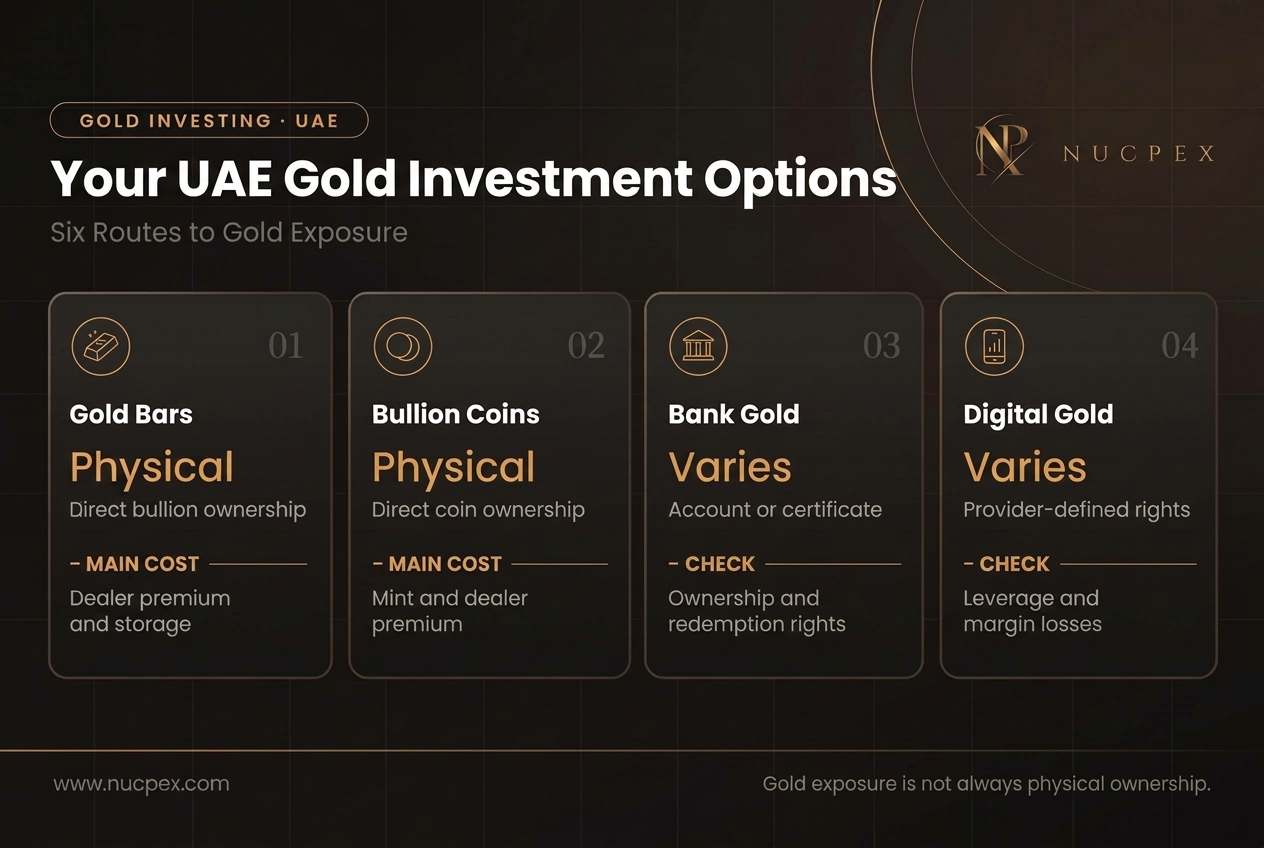
6 Ways to Invest in Gold in the UAE
Investors can choose between direct physical ownership and products that provide contractual or market-based exposure. Each option differs in minimum investment, fees, liquidity, and legal protections.
Understanding what you actually own is more important than choosing a product solely because it is advertised as gold-backed.
1. Buy Physical Gold Bars
Gold bars are a straightforward way to acquire physical bullion. UAE dealers offer different weights and purity levels, with 999.9 fine gold commonly marketed for investment purposes.
Compare the quoted price against the international gold benchmark, adjusted for weight and currency. Ask for an itemized invoice, purity documentation, and the dealer’s current repurchase terms.
2. Purchase Gold Bullion Coins
Bullion coins provide physical gold ownership in recognizable denominations. Their investment value primarily reflects metal content, although minting and dealer premiums affect the purchase price.
Check the coin’s actual gold weight and purity. A 22-karat bullion coin can contain a specified quantity of fine gold despite weighing more overall. Its tax treatment must be assessed separately rather than assumed from its appearance.
3. Use UAE Bank Gold Accounts or Certificates
Some UAE banks offer gold-denominated accounts or certificates that allow customers to gain exposure without storing bars at home. Product structures differ substantially.
For example, Emirates NBD advertises an XAU-denominated gold account, while its gold savings certificates have separate denomination and redemption terms. Investors should verify whether their arrangement provides allocated ownership, an account claim, or physical delivery rights.
4. Invest Through Digital Gold Platforms
Digital gold services allow eligible customers to purchase gold through online platforms or banking applications. Some arrangements provide beneficial ownership of vaulted bullion; others may create contractual exposure.
Emirates Islamic, for example, describes a digital gold service with allocated holdings and specified redemption options. Other providers may use different custody, audit, minimum-purchase, and delivery arrangements.
Always review the provider’s legal documentation before treating an app balance as equivalent to gold held in your own name.
5. Buy Gold ETFs Through a Brokerage Account
Gold exchange-traded products allow investors to obtain exposure through securities traded on financial exchanges. UAE residents may access eligible international products through appropriately authorized brokers, subject to account and distribution restrictions.
Physically backed products generally track bullion prices after expenses, but their legal structures and redemption rights differ. Investors should examine annual fees, trading spreads, custody arrangements, and currency conversion costs.
For more detail, see our guide to what a gold ETF is.
6. Trade Gold Futures or Other Derivatives
Gold futures and other derivatives provide contractual exposure to price movements rather than straightforward ownership of retail bullion. They are commonly used for hedging or speculation.
The Dubai Gold and Commodities Exchange (DGCX) lists gold-related contracts, including futures. Contract specifications, settlement arrangements, and margin requirements must be checked individually.
Leverage can magnify losses, making derivatives unsuitable substitutes for uncomplicated long-term gold ownership.
Where Can You Buy Gold in Dubai?
Dubai offers physical gold through established retail districts, bullion dealers, and selected banking channels. However, a familiar shopping location does not independently establish a seller’s reliability.
The Dubai Gold Souk is a well-known retail destination, while specialist bullion dealers and refiners serve customers seeking investment bars. Investors should confirm the seller’s trade authorization, product authenticity, and buyback policies before payment.
How to Verify Gold Authenticity
Documentation and independent verification matter because purity, weight, and resale eligibility determine the value of bullion. Packaging alone should not be treated as conclusive proof.
Before purchasing, check:
- The stated fineness and exact gold weight;
- The refinery or mint’s identity and documentation;
- The invoice, serial number, and assay certificate where applicable;
- The dealer’s written buyback terms and applicable fees;
- Whether independent testing is available for larger purchases.
DMCC supports industry accreditation and responsible-sourcing initiatives, but it does not act as the general regulator of every Dubai gold retailer.
Gold Investment Options Compared
The best way to compare products is to separate ownership from price exposure. Direct possession provides control over the metal, while intermediated products may offer easier transactions.
The table below summarizes key considerations.
| Option | Ownership or Exposure | Main Cost | Main Concern |
| Gold Bars | Physical ownership | Premium, storage | Security and resale |
| Bullion Coins | Physical ownership | Mint and dealer premium | Higher spreads |
| Bank Gold Products | Product-dependent | Bank spread, fees | Contractual rights |
| Digital Gold | Product-dependent | Spread, custody | Provider and custody risk |
| Gold ETFs | Exchange-traded security | Fund fee, trading costs | Market and product risk |
| Gold Derivatives | Contractual exposure | Margin, trading costs | Leverage losses |
Actual availability and eligibility depend on the institution, product, and investor.
Is Gold Tax-Free in the UAE?
Gold taxation in the UAE depends on the type of transaction, product classification, and investor circumstances. The distinction between investment bullion and jewelry is particularly important.
Under UAE VAT rules, qualifying investment precious metals are zero-rated when they have at least 99% purity and are in a form tradable in global bullion markets. This does not mean every gold purchase is automatically VAT-free.
VAT on Gold Bars, Coins, and Jewelry
Qualifying investment bullion may receive zero-rated VAT treatment. Jewelry and other products that do not meet the investment precious metals definition can be subject to the standard 5% VAT rate.
Making charges and specialized transactions can involve additional VAT considerations. Request a proper tax invoice and confirm the applicable treatment before purchasing.
Capital Gains and Personal Investment Income
The UAE does not generally impose a separate personal capital gains tax on individuals’ qualifying private investments. The Federal Tax Authority also excludes personal investment income from the scope of corporate tax when relevant conditions are met.
However, commercial gold trading, business activities, corporate ownership, and overseas tax residency may produce different obligations. Investors should obtain qualified tax guidance when their circumstances are complex.
How Much Does Buying Gold in Dubai Really Cost?
The displayed gold rate is only a starting point. Dealers may charge premiums above the metal value, while resale quotations can include a discount.
Consider a hypothetical purchase with a gold value of AED 10,000. If the dealer charges a 3% premium, the purchase price becomes AED 10,300, assuming qualifying zero-rated bullion and no additional fees.
If the dealer later offers 2% below an unchanged underlying gold value, the resale proceeds would be AED 9,800.
The investor would lose AED 500, or approximately 4.85% of the initial outlay, despite no movement in the gold benchmark.
This is an illustrative calculation, not a quotation from a UAE dealer. Storage, insurance, and other expenses could increase the total cost.
How to Choose a Gold Investment in the UAE
Selecting a gold investment should begin with the intended purpose: physical ownership, long-term diversification, convenient trading, or short-term speculation.
A practical decision framework considers:
- Ownership: Do you require physical possession or allocated bullion?;
- Liquidity: How quickly can the investment be sold?;
- Costs: What are the purchase, holding, and exit charges?;
- Protection: Who holds the gold, and what rights do you have?;
- Suitability: Does the product match your investment horizon and risk capacity?
Gold prices can fall, and physical bullion produces no regular income. Currency exposure, concentration, and liquidity needs should also be considered.
Final Thoughts
Learning how to invest in gold in the UAE involves understanding both the investment itself and the local market in which it is purchased.
Dubai offers access to physical bullion, banking products, digital gold, international exchange-traded securities, and derivatives. Yet these products differ in ownership, taxes, costs, and regulatory protections.
The most useful starting point is to verify what you are buying, compare the full cost of ownership, and understand how the investment fits into your broader financial objectives.
At NUCPEX, we emphasize financial education, transparent analysis, and investment decisions grounded in individual circumstances and realistic risk assessments.
Disclaimer: This article provides general financial education, not personalized investment or tax advice. Gold prices can decline, and product terms and UAE regulations may change.
Frequently Asked Questions
1. Can UAE expatriates invest in gold?
Yes. Expatriates can generally purchase physical gold, while access to bank accounts, brokerage products, and digital platforms depends on residency, identification, and provider eligibility requirements.
2. Is buying gold monthly better than making one large purchase?
Regular purchases spread entry prices over time, while a lump-sum purchase provides immediate exposure. Neither approach guarantees superior returns, and repeated dealer premiums can make small purchases expensive.
3. Is gold bought in Dubai automatically certified?
No. Certification and documentation vary by seller and product. Investors should request verifiable purity, weight, refinery, and purchase records rather than relying on location alone.

No Comments Yet