
How to Buy Gold Coins: A Beginner’s Guide
Gold coins offer a way to own physical precious metal without relying entirely on financial securities or digital investment platforms. They are available in different sizes, designs, and purity levels, making them accessible to investors with different budgets.
However, buying gold coins involves more than comparing their appearance or following changes in the international gold price. The type of coin, its actual gold content, dealer premiums, authenticity, and resale conditions all influence the investment’s value.
A coin can contain genuine gold and still be a poor purchase if its price is significantly higher than the value of its precious metal content.
This guide explains how to buy gold coins, compare popular investment coins, calculate their costs, and avoid common mistakes.
What Are Gold Investment Coins?
Gold investment coins, commonly called bullion coins, are coins whose market value is primarily determined by their precious metal content and the prevailing gold price.
Many bullion coins are issued by government mints and have a stated face value. However, their investment value is generally much higher than that nominal amount.
Unlike jewelry, bullion coins are produced with standardized specifications that make their weight, purity, and origin easier to identify.
Their value can still fluctuate significantly, and ownership involves transaction and storage costs.
Bullion Coins vs. Collectible Gold Coins
Not every gold coin is purchased primarily for its metal content. Understanding the difference between bullion and numismatic coins is essential before comparing prices.
Bullion Gold Coins
Bullion coins are generally purchased to gain exposure to physical gold. Their prices are influenced mainly by the market value of their gold content plus a dealer premium.
Well-known examples include the American Gold Eagle, Canadian Gold Maple Leaf, British Britannia, and South African Krugerrand.
Numismatic Gold Coins
Numismatic coins are valued partly for their rarity, age, condition, historical significance, or collector demand.
Their prices may be considerably higher than their underlying gold value. This creates additional valuation and resale risks, particularly for buyers without specialist knowledge.
| Feature | Bullion Coins | Numismatic Coins |
| Primary Value | Gold content | Gold content and collectibility |
| Pricing | Spot price plus premium | Collector-dependent valuation |
| Main Buyer | Precious-metal investor | Collector or specialist |
| Resale | Often standardized | Depends on collector demand |
| Main Risk | Gold price and transaction costs | Gold price, rarity, and valuation |
For beginners primarily seeking gold exposure, standardized bullion coins are generally easier to evaluate than rare collectible coins.
How to Buy Gold Coins: 7 Practical Steps
A structured buying process helps investors compare products and understand the full cost before committing money.
These steps apply broadly to physical bullion purchases, although local laws, available dealers, and product specifications may differ.
1. Define Your Investment Objective
Start by deciding why you want to own physical gold. Possible objectives include portfolio diversification, long-term wealth preservation, or holding a tangible asset.
Gold does not generate interest or dividends. Its investment return depends on changes in market value and the costs of buying, storing, and selling it.
2. Choose a Recognized Bullion Coin
Compare established coin programs with published specifications from official mints.
Recognizable coins may be easier for dealers to assess, but international popularity does not guarantee the best local resale price.
Check whether the coin is a standard bullion issue rather than a proof, commemorative, or collector edition.
3. Check Weight and Purity
Gold coins are commonly described by their fine gold content, such as one troy ounce, half an ounce, or one-tenth of an ounce.
Purity is usually expressed as a percentage or fineness. A coin with .9999 fineness contains 99.99% gold by weight, while a 22-karat coin contains approximately 91.67% gold.
Importantly, some 22-karat bullion coins contain one full troy ounce of pure gold even though their total physical weight is greater because they include alloy metals.
4. Compare the Spot Price and Premium
The spot price is a benchmark for the market value of gold, commonly quoted in U.S. dollars per troy ounce.
A dealer normally charges more than the underlying metal value. This additional amount is called the premium and may reflect production, distribution, inventory, and dealer costs.
Compare premiums using the same fine gold content rather than simply comparing the total prices of different-sized coins.
5. Verify the Dealer and Coin Authenticity
Research the dealer’s business identity, physical address, trading history, and applicable registration or licensing requirements.
Ask how authenticity is checked and whether the dealer provides documentation identifying the coin, its specifications, and the transaction.
Do not rely exclusively on photographs, verbal assurances, or unusually attractive prices.
6. Review Storage, Insurance, and Delivery
Physical coins require secure storage. Options may include appropriate home security arrangements or professional vaulting services.
Compare the costs, insurance coverage, access restrictions, and responsibilities associated with each arrangement.
If coins are delivered, confirm the shipping method, insurance terms, and procedure for reporting damage or loss.
7. Understand How You Will Sell
Before purchasing, ask whether the dealer buys back the same type of coin and how its repurchase price is calculated.
The dealer’s buyback price may be lower than the current spot value, particularly for less common products or during difficult market conditions.
Understanding resale conditions in advance helps avoid unexpected costs when converting coins back into cash.
Popular Gold Bullion Coins Compared
Several government-issued bullion coins are widely recognized in international precious-metal markets. Their specifications differ, even when they contain the same amount of fine gold.
The following examples focus on standard one-troy-ounce gold bullion versions.
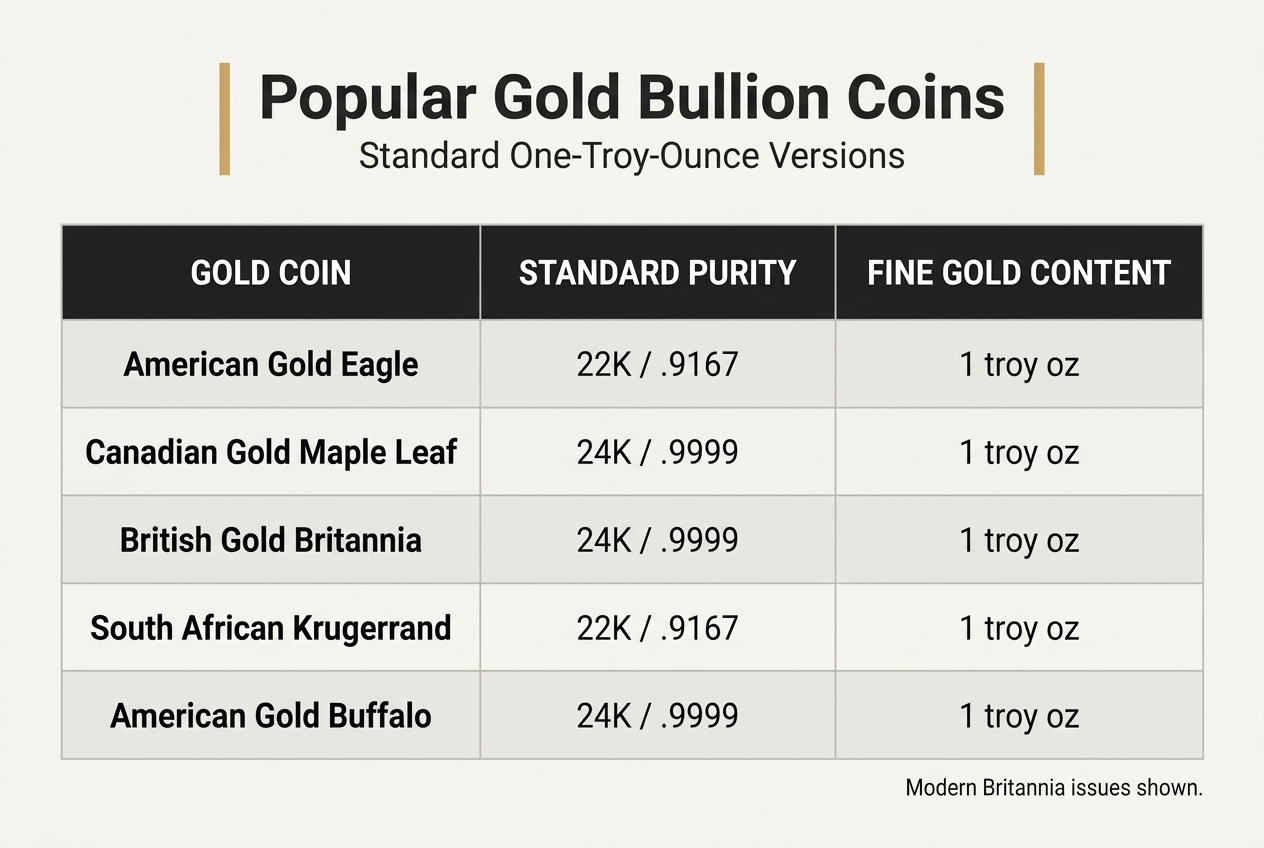
A higher purity percentage does not automatically mean a standard one-ounce coin contains more gold.
For example, both a one-ounce American Gold Eagle and a one-ounce Canadian Gold Maple Leaf contain approximately 31.1035 grams of fine gold, despite having different total weights and alloy compositions.
How Much Does It Cost to Buy Gold Coins?
The final purchase price generally includes the value of the fine gold content and an additional dealer premium.
Depending on the location and transaction, buyers may also face shipping, insurance, payment-processing charges, or applicable taxes.
A simplified calculation is:
Coin Purchase Price = Fine Gold Value + Dealer Premium + Additional Charges
Example: Calculating a Gold Coin Premium
Assume the hypothetical gold spot price is $3,000 per troy ounce.
A dealer offers a one-ounce bullion coin for $3,150, excluding other charges.
- Spot Gold Value: $3,000;
- Dealer Premium: $150;
- Premium Percentage: 5%.
The calculation is:
Premium (%) = (Coin Price − Fine Gold Value) ÷ Fine Gold Value × 100
In this example, the buyer pays 5% above the underlying gold value.
If the dealer’s immediate buyback quote is $2,970, the buyer would face an immediate hypothetical loss of $180, or approximately 5.71% of the purchase price, before other costs.
This demonstrates why a gold coin’s resale value matters as much as its purchase price.
What Is the Difference Between Gold Coin Premium and Spread?
A premium is the amount paid above the underlying gold value when purchasing a coin.
The dealer spread is the difference between the dealer’s selling price and buying price for the same product at a particular time.
A narrow premium does not necessarily guarantee an attractive resale price. Investors should request both quotations whenever possible.
The gold price must move sufficiently in the investor’s favor to overcome these costs before a net profit becomes possible.
Are Smaller Gold Coins Better for Beginners?
Smaller denominations can make physical gold accessible without requiring the budget for a full one-ounce coin.
They may also provide flexibility when selling only part of a collection.
However, fractional coins frequently carry higher premiums per ounce of fine gold because production and distribution costs are spread across smaller quantities.
For example, purchasing ten one-tenth-ounce coins may cost more than purchasing one full-ounce coin containing the same total quantity of gold.
The appropriate choice depends on available capital, expected resale needs, and total costs.
Gold Coins vs. Gold Bars: Which Is Better?
Gold coins and bars both provide physical exposure to gold, but they differ in standardization, denomination, production costs, and resale considerations.
Coins may offer recognizable designs and convenient smaller sizes. Larger bars may provide lower premiums per ounce, although selling a portion of a single large bar is not practical.
| Consideration | Gold Coins | Gold Bars |
| Recognition | Established mint programs | Established refiners |
| Available Sizes | Commonly fractional ounces | Grams to large bars |
| Premiums | Often higher per ounce | Often lower for larger bars |
| Partial Resale | Possible with multiple coins | Depends on bar sizes |
| Storage | Requires secure storage | Requires secure storage |
| Authenticity | Mint specifications and testing | Refiner markings and testing |
Neither is universally better. The decision should reflect costs, authenticity, liquidity, and investment objectives.
How to Check Whether a Gold Coin Is Authentic
Counterfeit coins are a significant concern in the physical precious-metals market. Visual inspection alone may not reliably identify sophisticated counterfeits.
A reputable dealer should be able to explain its verification process and the equipment or professional testing methods used.
Common verification measures include:
- Weight Measurement: Checking the coin against official specifications;
- Diameter and Thickness: Comparing physical dimensions;
- Visual Inspection: Examining design details and minting quality;
- Professional Testing: Using appropriate non-destructive testing methods;
- Provenance: Reviewing invoices and credible transaction records.
No single basic test should be treated as conclusive. Avoid damaging coins with improvised tests that could reduce resale value.
Risks of Investing in Gold Coins
Physical gold ownership introduces risks that differ from holding securities in a brokerage account.
Gold prices can decline, and transaction expenses can make profitable resale difficult even when the international spot price increases moderately.
Important risks include:
- Market Risk: Gold prices may fall or remain weak for extended periods;
- Premium Risk: Purchase premiums may not be recovered;
- Liquidity Risk: Resale offers can vary across dealers;
- Counterfeit Risk: Coins may be misrepresented or inauthentic;
- Storage Risk: Theft, loss, and insurance limitations;
- Currency Risk: Local-currency returns may differ from U.S.-dollar price changes;
- Opportunity Cost: Physical gold does not generate regular income.
Gold coins should therefore be evaluated as part of an overall investment strategy, not as a guaranteed method of preserving wealth.
Common Mistakes When Buying Gold Coins
First-time buyers may focus too heavily on the coin’s appearance or the reputation of the issuing mint while overlooking the economics of the transaction.
Avoid these common mistakes:
- Purchasing collectible coins without understanding numismatic valuation;
- Comparing total prices without adjusting for fine gold content;
- Ignoring premiums, buyback spreads, and storage expenses;
- Assuming 24-karat coins always contain more gold than 22-karat bullion coins;
- Buying from unverified social media sellers;
- Failing to request an invoice or transaction documentation;
- Assuming gold prices can only increase during inflation or geopolitical uncertainty.
A careful purchasing process should prioritize verifiable specifications, transparent pricing, and realistic resale expectations.
A Gold Coin Buying Checklist
Before completing a transaction, review the essential product and dealer information.
Use the following checklist:
- Coin Type: Is it a standard bullion coin or a collectible issue;
- Mint: Is the issuing institution identifiable and reputable;
- Fine Gold Content: Is the actual quantity of gold confirmed;
- Purchase Premium: How much above spot are you paying;
- Buyback Quote: What would the dealer pay to repurchase it;
- Authenticity: How is the coin verified;
- Documentation: Will you receive a detailed invoice;
- Storage: Are security and insurance arrangements adequate;
- Total Cost: Have delivery, fees, and relevant taxes been considered.
If the seller cannot explain the price or verify the product’s specifications, additional due diligence is warranted.
Final Thoughts
Buying gold coins can provide direct ownership of a tangible asset, but successful purchasing decisions depend on understanding more than the international gold price.
The most important considerations include fine gold content, coin recognition, dealer credibility, purchase premiums, authenticity, and resale conditions.
For beginners, standardized bullion coins are generally easier to evaluate than collectible coins with complex pricing.
At NUCPEX, we emphasize informed financial decisions, transparent market analysis, and a disciplined understanding of investment costs and risks.
Disclaimer: This article provides general financial education and does not constitute personalized investment advice. Gold prices fluctuate, and physical gold investments can result in financial losses.
Frequently Asked Questions
1. What is the best gold coin to buy for investment?
There is no universally best coin. Recognized bullion coins with transparent specifications and competitive purchase and resale prices may be easier to evaluate.
2. Is it better to buy 22K or 24K gold coins?
Both can be suitable for bullion ownership. Compare their actual fine gold content, premiums, and resale conditions rather than purity alone.
3. Do gold coins increase in value over time?
They may appreciate when gold prices rise, but gains are not guaranteed. Premiums, spreads, and storage costs can reduce investment returns.
4. Can I sell gold coins back to a dealer?
Many bullion dealers offer buyback services, but prices and conditions vary. Confirm the dealer's repurchase policy before buying.
5. Do gold coins have to be stored in a bank?
No. Storage options may include secure private arrangements or professional vaults. Each option has different costs, access conditions, and security considerations.
No Comments Yet