
What Is a Cryptocurrency Exchange? | Types & Safety Risks
Buying Bitcoin or another digital asset usually begins with a cryptocurrency exchange. These platforms allow people to convert traditional currencies into cryptocurrencies, exchange one digital asset for another, and, in some cases, withdraw their holdings to external wallets.
But what is a cryptocurrency exchange, and is it safe?
A crypto exchange is a digital trading service that connects buyers and sellers or facilitates transactions through another trading mechanism. Although exchanges can make cryptocurrency trading more accessible, they also introduce risks involving cybersecurity, custody, regulation, liquidity, and market volatility.
Understanding how these platforms operate is essential before depositing money or transferring digital assets.
What Is a Cryptocurrency Exchange?
A cryptocurrency exchange is an online platform that facilitates the buying, selling, or exchange of cryptocurrencies and other supported digital assets.
Depending on the service, users may trade cryptocurrencies against traditional currencies such as the U.S. dollar or against other digital assets. Some platforms also provide custody, allowing customers to hold balances within exchange-controlled accounts.
Not every crypto trading service operates as a traditional exchange. Certain providers act as brokers, dealers, or transaction facilitators rather than matching orders between independent buyers and sellers.
If you want to know more about crypto currencies, read our article “What Is Crypto Currency Mining?A Beginner’s Guide”
How Does a Cryptocurrency Exchange Work?
Most exchange transactions begin when a user creates an account or connects a compatible digital wallet. The platform then provides access to supported trading pairs and displays available prices.
The precise process depends on whether the exchange is centralized or decentralized, as well as the services offered in the user’s jurisdiction.
Step 1: Account Registration or Wallet Connection
Centralized exchanges commonly require users to create accounts and complete identity verification. These procedures may involve submitting identification documents and other information required by applicable anti-money-laundering rules.
Decentralized exchanges often allow users to connect a compatible blockchain wallet instead, although regulatory requirements and access restrictions can still apply.
Step 2: Funding the Account
Users may deposit supported fiat currencies or transfer cryptocurrencies from another wallet. Funding methods, processing times, and fees vary by provider.
Before sending cryptocurrency, users must verify the correct blockchain network and destination address. Transfers to incompatible or incorrect addresses may be irreversible.
Step 3: Placing a Trade
On an order-book exchange, buyers submit bids and sellers submit offers. The trading system matches compatible orders according to its execution rules.
For example, a user might exchange a hypothetical $500 for Bitcoin at the available execution price. The amount received depends on the market price, fees, and any slippage.
Step 4: Holding or Withdrawing Assets
After a transaction, purchased assets may remain in an exchange-controlled account or be withdrawn to a compatible external wallet.
The distinction matters because control over private keys determines who can authorize blockchain transactions.
Centralized vs. Decentralized Cryptocurrency Exchanges
Cryptocurrency exchanges generally fall into two broad categories: centralized exchanges (CEXs) and decentralized exchanges (DEXs).
Both facilitate digital asset transactions, but they differ in custody arrangements, trading infrastructure, governance, and operational risks.
Centralized Exchanges (CEXs)
A centralized exchange is operated by a company that provides trading infrastructure and typically manages customer accounts. Many offer fiat deposits, order books, customer support, and identity verification.
When assets are held in an exchange-controlled wallet, customers rely on the provider’s security, financial condition, and withdrawal arrangements.
Decentralized Exchanges (DEXs)
A decentralized exchange commonly uses blockchain-based smart contracts to facilitate swaps between supported tokens. Users generally connect self-custody wallets rather than transferring assets to a traditional exchange account.
However, decentralized trading introduces risks involving smart-contract vulnerabilities, malicious tokens, transaction approvals, liquidity pools, and network fees.
CEX vs. DEX: Key Differences
| Feature | Centralized Exchange | Decentralized Exchange |
| Operation | Company-managed | Smart contracts and protocols |
| Account Access | Usually registered account | Usually connected wallet |
| Custody | Often exchange-controlled | Usually user-controlled |
| Fiat Support | Often available | Usually limited or indirect |
| Main Security Risk | Custody and platform failure | Smart contracts and wallet permissions |
| Customer Support | Often available | Often limited |
| Identity Checks | Commonly required | Varies by service and jurisdiction |
Neither structure is automatically safer. The risks are different rather than absent.
Is a Cryptocurrency Exchange Safe?
A cryptocurrency exchange can implement strong security measures and operate under regulatory supervision, but these protections do not eliminate the possibility of financial loss.
Safety should be evaluated across three separate dimensions: platform security, custody and financial resilience, and the risks associated with the digital assets themselves.
Cybersecurity and Account Protection
Exchanges may face phishing attacks, compromised credentials, malicious software, and unauthorized account access.
Multi-factor authentication, withdrawal restrictions, and suspicious-activity monitoring can reduce some risks. However, even sophisticated security systems cannot guarantee that a platform will never experience a breach.
Custody and Exchange Failure
When a centralized platform holds assets for customers, users depend on its ability and willingness to return those assets.
An exchange may experience operational failures, liquidity shortages, insolvency, or restrictions on withdrawals. The failure of a service provider is a different risk from a decline in cryptocurrency prices.
Cryptocurrency Market Risk
Even if an exchange functions correctly, the cryptocurrency being traded may lose substantial value. Market prices can change rapidly, particularly for less liquid tokens.
Stablecoins may also face reserve, redemption, issuer, or depegging risks. A stable price target is not a guarantee of stability.
What Are the Biggest Risks of Using Crypto Exchanges?
Different exchanges have different business models, but several risks deserve attention regardless of platform size or popularity.
These risks may affect both beginners and experienced users.
- Hacking: Unauthorized access to platform or customer assets;
- Phishing: Fraudulent websites and messages designed to steal credentials;
- Insolvency: Failure of an exchange or affiliated service provider;
- Withdrawal Restrictions: Delays, suspensions, or transaction limits;
- Market Manipulation: Misleading prices or abusive trading activity;
- Liquidity Risk: Difficulty executing transactions at expected prices;
- Regulatory Risk: Changes in product availability or legal permissions;
- User Error: Incorrect wallet addresses or blockchain networks.
Using a well-known platform does not remove these risks.
How to Choose a Cryptocurrency Exchange
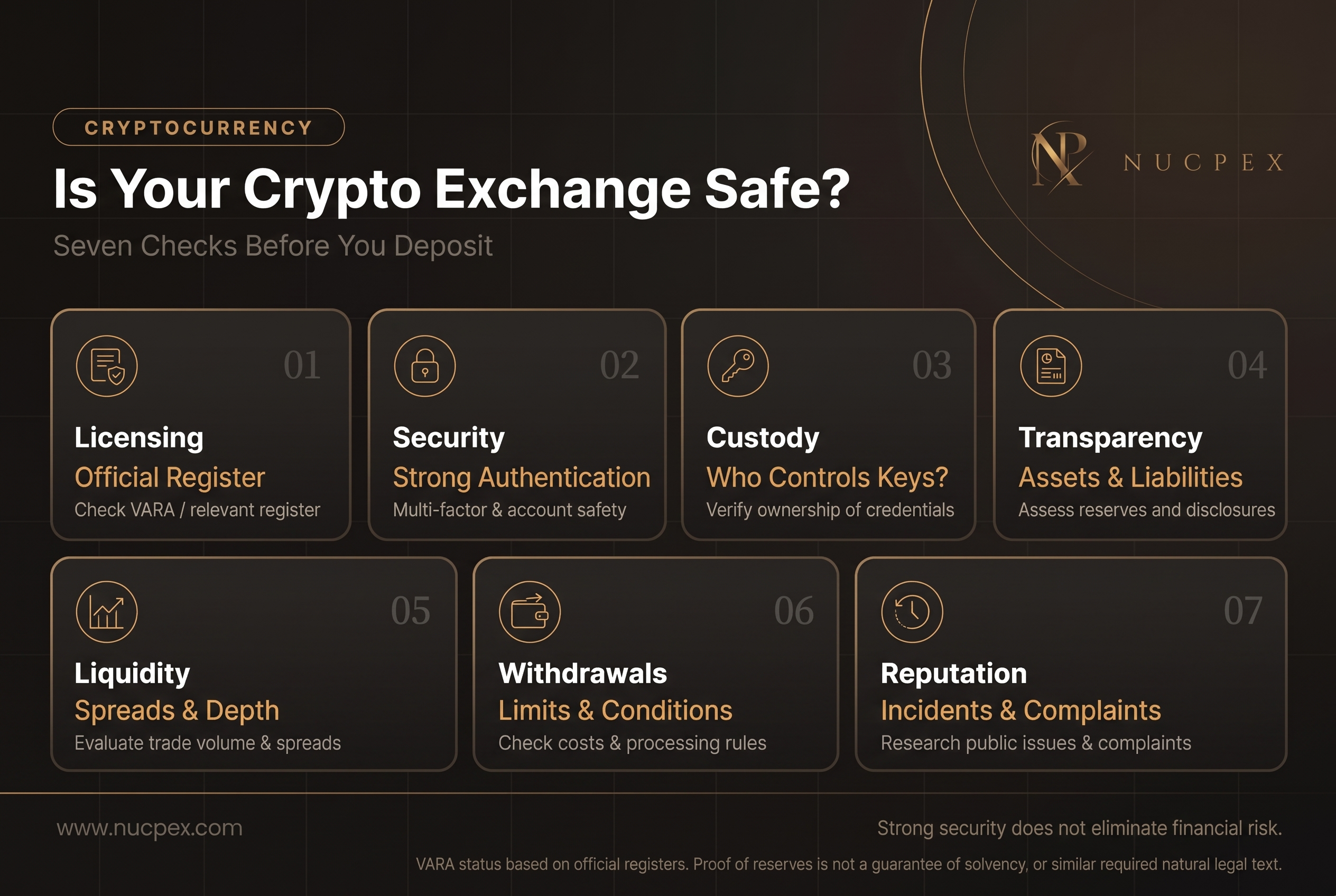
Selecting an exchange requires more than comparing advertised trading fees. Users should investigate the provider’s legal identity, regulatory status, custody arrangements, and operating conditions.
The following checks can help identify important warning signs before opening an account.
Verify Its Regulatory Status
Check the relevant regulator’s official register rather than relying on claims displayed on the exchange’s website.
For users in Dubai outside the Dubai International Financial Centre, VARA publishes a public register of virtual asset service providers and their authorized activities. Regulatory arrangements differ in other UAE jurisdictions.
Evaluate Security and Custody
Review the exchange’s account protections, withdrawal procedures, custody disclosures, and incident history.
A platform’s published proof-of-reserves information may offer some transparency, but asset snapshots alone do not necessarily establish that customer liabilities are fully covered or that the business is solvent.
Compare Fees and Liquidity
Trading commissions are only one part of the cost. Spreads, slippage, deposit charges, withdrawal fees, and network transaction costs may affect the total amount paid.
Liquidity also varies by asset and trading pair. A platform with competitive Bitcoin pricing may offer less favorable execution for smaller tokens.
Review Withdrawal Conditions
Understand whether customers can withdraw supported assets to external wallets, what verification is required, and whether limits apply.
A platform that provides clear withdrawal terms is easier to evaluate than one with vague or frequently changing restrictions.
Crypto Exchange vs. Crypto Wallet: What’s the Difference?
A cryptocurrency exchange primarily facilitates transactions, while a cryptocurrency wallet provides a way to manage the cryptographic keys or permissions used to control digital assets.
The distinction becomes especially important when deciding where to hold assets after a purchase.
Custodial Wallets
In a custodial arrangement, a provider controls the private keys associated with customer assets. Users access their balances through the provider’s systems.
This can simplify account recovery and transactions, but it creates dependence on the custodian.
Self-Custody Wallets
With self-custody, users control the credentials needed to authorize transactions. This reduces dependence on an exchange for access to those assets.
However, losing a recovery phrase, exposing private keys, or approving malicious transactions can result in permanent losses. Self-custody transfers responsibility rather than eliminating risk.
After choosing a good crypto currency exchange, and before investing on crypto, read the article “3 Superior Cryptocurrencies to Buy and Hold for 10 Years“.
How to Use a Crypto Exchange More Safely
Security practices can reduce the likelihood of common account compromises and transaction mistakes. They cannot eliminate platform failure, market losses, or other risks.
Practical precautions include:
- Verify the Website: Use official URLs and avoid suspicious links;
- Enable Strong Authentication: Prefer phishing-resistant methods where supported;
- Use Unique Credentials: Protect accounts with strong, distinct passwords;
- Check Withdrawal Addresses: Confirm networks and destination details;
- Start With Small Transfers: Test unfamiliar withdrawal procedures;
- Avoid Excessive Balances: Evaluate whether exchange custody is necessary;
- Review Account Activity: Monitor transactions and security notifications;
- Be Skeptical of Guarantees: Avoid platforms promising risk-free returns.
Never share private keys, wallet recovery phrases, or authentication codes with someone claiming to provide customer support.
Are Cryptocurrency Exchanges Regulated in the UAE?
The UAE has established regulatory frameworks for virtual asset activities, but requirements depend on the location, activity, and relevant authority.
In Dubai, VARA regulates virtual asset activities across the emirate’s mainland and most free zones, excluding the DIFC, which has its own financial regulatory framework.
VARA’s public register distinguishes fully licensed providers from those holding In-Principle Approval. An In-Principle Approval does not authorize a company to begin providing virtual asset services to customers.
Users should verify the specific legal entity and the activities it is permitted to conduct. A license for one service does not automatically authorize every cryptocurrency-related activity.
Common Cryptocurrency Exchange Scams
Fraudsters may imitate legitimate exchanges, advertise fabricated investment results, or pressure users to transfer cryptocurrency to unfamiliar addresses.
Some fraudulent platforms initially display artificial profits, then demand additional payments before supposedly allowing withdrawals.
Warning signs include:
- Guaranteed or unusually consistent investment returns;
- Pressure to deposit immediately;
- Unverifiable licenses or company details;
- Requests to transfer funds to personal wallets;
- Unexpected fees required to unlock withdrawals;
- Customer support asking for private keys or recovery phrases.
If a platform appears suspicious, independently verify its identity before providing money or personal information.
Final Thoughts
A cryptocurrency exchange provides access to digital asset trading, but convenience should never be confused with guaranteed safety.
Centralized and decentralized platforms expose users to different combinations of custody, technology, operational, and financial risks. Regulation, transparent disclosures, and strong account security can reduce some risks without eliminating them.
Before using any exchange, understand who controls the assets, how withdrawals work, what fees apply, and which protections are actually available.
At NUCPEX, we emphasize financial education, transparent market analysis, and careful evaluation of digital asset risks.
Disclaimer: This article is for general educational purposes and does not constitute personalized investment advice or an endorsement of any cryptocurrency exchange. Digital assets can experience substantial or total losses.
Frequently Asked Questions
1. Can a cryptocurrency exchange be hacked?
Yes. Exchanges and their customers can be targeted by cyberattacks and phishing. Security controls reduce risk but cannot guarantee complete protection.
2. Is it safe to leave Bitcoin on an exchange?
Keeping Bitcoin on an exchange introduces custodial and counterparty risks. Self-custody avoids some of those risks but creates responsibility for protecting private keys and recovery information.
3. Are decentralized exchanges safer than centralized exchanges?
Not necessarily. DEXs may reduce reliance on a centralized custodian, but smart-contract failures, malicious tokens, and wallet-approval mistakes can still cause losses.
4. Can I recover cryptocurrency if an exchange shuts down?
Recovery depends on the provider's legal structure, custody arrangements, applicable laws, and available assets. Customers may face delays or recover only part of their holdings.
5. How can I check whether a crypto exchange is licensed in Dubai?
Search the official VARA Public Register for the provider's legal entity, license status, and authorized activities. Check that it holds a full license for the relevant service, not merely In-Principle Approval.

No Comments Yet