
Major World Stock Market Indexes

Stock market headlines frequently report movements in the S&P 500, Nasdaq-100, FTSE 100, and Nikkei 225. These indexes help investors understand how different equity markets are performing, but they do not all measure the same companies or economic conditions.
Understanding world stock market indexes is essential for comparing international markets, evaluating investment performance, and recognizing geographic or sector concentration.
This guide introduces major global stock indexes, explains how they are calculated, and shows why differences in methodology, dividends, and currency exposure matter when interpreting market returns.
Stock Market Indexes
A stock market index measures the performance of a selected group of publicly traded securities. Its composition follows rules established by an index provider, such as S&P Dow Jones Indices, MSCI, FTSE Russell, or Nasdaq.
Some indexes represent large companies within one country, while others track industries, regions, or international equity markets. An index is a measurement benchmark, not a security investors can purchase directly.
Want to know more about stock market? Read our article “Stock Market Introduction; A Beginner’s Guide“.

How Do Stock Market Indexes Work?
Index providers establish eligibility criteria, select securities, calculate their relative weights, and periodically review membership. Index values change as the prices of their constituent securities fluctuate.
An index’s weighting methodology determines which companies influence its movements most strongly. Consequently, two indexes covering the same country can report different performance.
Market-Capitalization-Weighted Indexes
Market-capitalization weighting gives larger companies greater influence. Many widely followed indexes use free-float-adjusted market capitalization, which considers shares generally available to public investors.
For example, a company representing 10% of an index’s weight will typically have more influence than a company representing 1%, assuming comparable percentage price movements.
Price-Weighted Indexes
Price-weighted indexes give greater influence to securities with higher adjusted share prices, rather than necessarily to companies with greater market value.
The Dow Jones Industrial Average and Japan’s Nikkei 225 use price-weighted methodologies. Corporate actions and divisor adjustments help preserve index continuity.
Major Stock Market Indexes in the United States
U.S. indexes receive significant international attention because American companies represent a substantial portion of global equity market capitalization.
However, these benchmarks differ in company selection, sector exposure, and calculation methods.
S&P 500
The S&P 500 includes 500 leading U.S. companies and covers approximately 80% of available U.S. equity market capitalization. It is widely used as a benchmark for large-cap American stocks.
Its free-float-adjusted market-cap weighting means larger constituents have greater influence on performance.
Dow Jones Industrial Average
The Dow Jones Industrial Average tracks 30 established U.S. companies. Its price-weighted structure makes it different from the broader S&P 500.
Although widely reported, the Dow should not be treated as a complete representation of the U.S. stock market.
Nasdaq-100
The Nasdaq-100 tracks 100 of the largest non-financial companies listed on Nasdaq, including eligible international businesses.
It uses modified market-capitalization weighting and has substantial exposure to technology-oriented and growth companies. It is not identical to the Nasdaq Composite, which covers a broader collection of Nasdaq-listed securities.
Major European Stock Market Indexes
European stock markets include companies across financial services, industrial manufacturing, healthcare, consumer products, and energy.
Country benchmarks are useful, but multinational companies can earn substantial revenue outside their home markets.
FTSE 100 — United Kingdom
The FTSE 100 represents 100 leading companies listed on the London Stock Exchange, selected according to index eligibility and capitalization rules.
It is an important benchmark for UK-listed large-cap equities, although many constituents operate internationally.
DAX 40 — Germany
Germany’s DAX tracks 40 major companies listed on the Frankfurt Stock Exchange’s regulated market that meet its eligibility requirements.
Its commonly quoted performance-index version incorporates reinvested dividends. This is important when comparing it with price-only indexes elsewhere.
CAC 40 and EURO STOXX 50
France’s CAC 40 follows 40 prominent companies listed on Euronext Paris. The EURO STOXX 50 represents 50 major blue-chip companies from euro-area countries.
The distinction matters: one measures a national equity market segment, while the other covers companies across several euro-area markets.
Major Asian Stock Market Indexes
Asian equity markets differ considerably in economic structure, investor participation, and sector composition.
Investors should avoid treating the region as one uniform market simply because its exchanges operate in overlapping time zones.
Nikkei 225 and TOPIX — Japan
The Nikkei 225 tracks 225 selected Japanese stocks and uses price weighting. TOPIX provides broader Japanese equity-market coverage through a free-float-adjusted market-cap approach.
Their different methodologies can produce noticeably different returns even when both reflect Japanese equities.
Hang Seng and CSI 300 — Greater China
Hong Kong’s Hang Seng Index measures a selected group of major Hong Kong-listed companies. The CSI 300 covers 300 large and liquid A-share securities traded on mainland Chinese exchanges.
These benchmarks represent different listing markets, investor-access arrangements, and currency environments.
Nifty 50 and S&P/ASX 200
India’s Nifty 50 tracks 50 major companies listed on the National Stock Exchange of India. Australia’s S&P/ASX 200 covers approximately 200 eligible Australian-listed securities.
Both are widely used to assess domestic equity-market performance, but their sector compositions differ substantially.
Global Indexes: MSCI World vs. MSCI ACWI
A global stock index combines companies from multiple countries into one benchmark. However, the word global does not guarantee that every investable market is included.
Investors should examine country classification, company-size coverage, and weighting methodology before assuming that an index provides comprehensive diversification.
MSCI World Index
The MSCI World Index covers large- and mid-cap companies across 23 developed markets. It is widely used as a developed-market equity benchmark.
Despite its name, MSCI World excludes emerging markets. Its country weights also reflect market capitalization rather than equal representation.
MSCI ACWI and FTSE All-World
The MSCI All Country World Index (ACWI) includes large- and mid-cap equities across developed and emerging markets. MSCI’s published methodology identifies 23 developed and 24 emerging markets.
The FTSE All-World Index also combines developed and emerging markets, but its country classifications, constituents, and methodology are not identical to MSCI ACWI.
Comparison of Major World Stock Market Indexes
The following overview highlights what commonly followed indexes are designed to measure. Constituent counts and classifications may change as index providers update their methodologies.
| Index | Main Market | Coverage |
| S&P 500 | United States | 500 leading companies |
| Dow Jones | United States | 30 established companies |
| Nasdaq-100 | Nasdaq-listed | 100 large non-financial companies |
| FTSE 100 | United Kingdom | 100 major UK-listed companies |
| DAX | Germany | 40 leading companies |
| Nikkei 225 | Japan | 225 selected stocks |
| CSI 300 | Mainland China | 300 A-share securities |
| Nifty 50 | India | 50 leading companies |
| MSCI World | Developed markets | Large- and mid-cap equities |
| MSCI ACWI | Developed and emerging | Large- and mid-cap equities |
Why Can Global Index Returns Be Misleading?
Comparing index levels alone is not meaningful because indexes have different starting values and calculation conventions. Percentage returns provide a more useful starting point, but they still require careful interpretation.
Three important factors can materially change the comparison.
Dividends and Total Returns
A price-return index measures changes in security prices without including reinvested dividends. A total-return index incorporates dividends according to its methodology.
Comparing Germany’s commonly quoted DAX performance index with a price-only benchmark can therefore produce misleading conclusions.
Currency Movements
International returns depend on the investor’s reference currency. A foreign stock index may rise in local-currency terms while producing a smaller gain—or a loss—after exchange-rate conversion.
For example, a hypothetical 8% local-market return combined with a 10% currency depreciation against the investor’s home currency produces approximately a 2.8% loss before costs.
Concentration and Sector Exposure
An index containing hundreds of companies is not necessarily evenly diversified. Large technology companies, financial institutions, or individual countries may dominate market-cap-weighted benchmarks.
Investors should review country and sector weights rather than relying solely on the number of constituent companies.
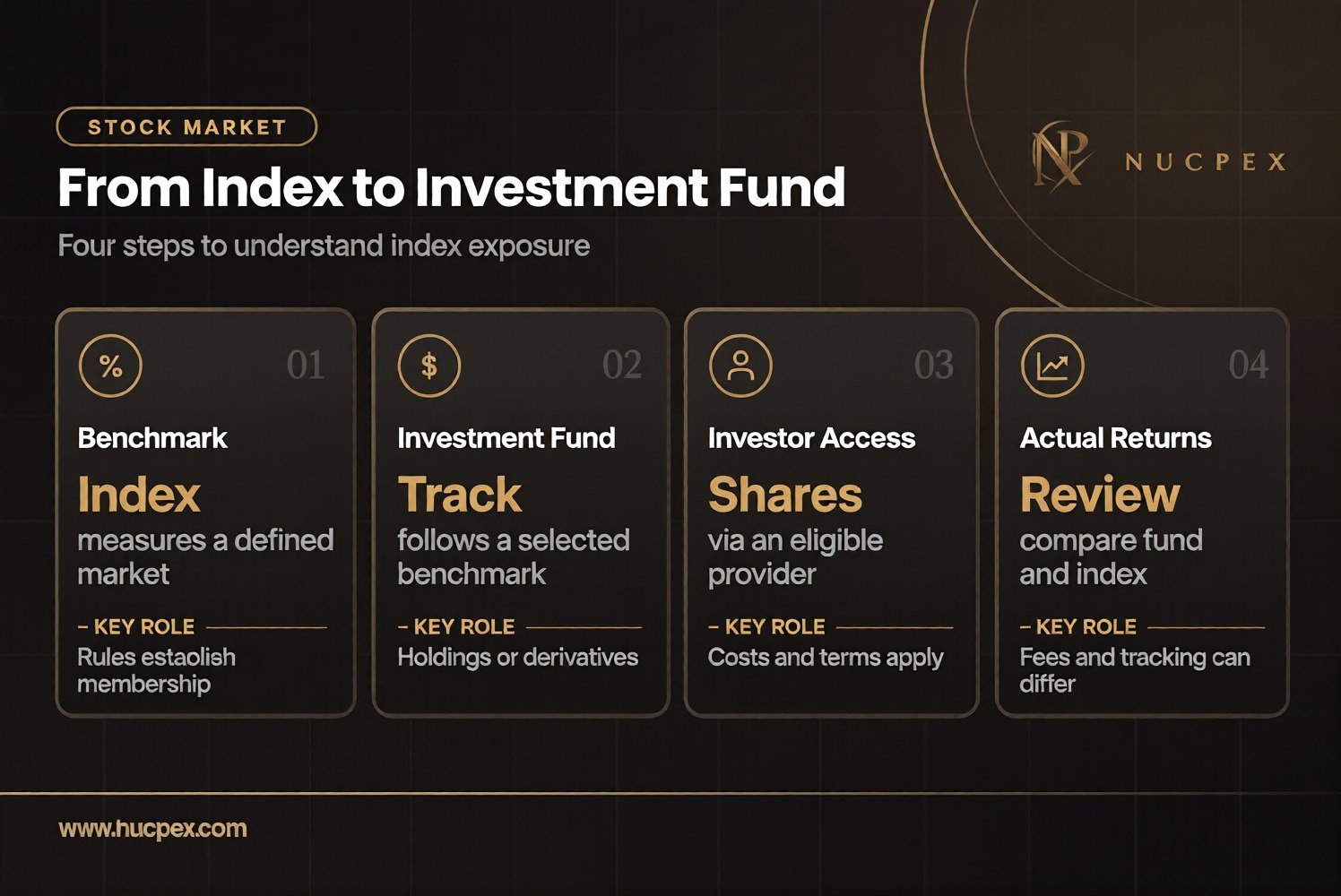
How Can Investors Invest in Stock Market Indexes?
Indexes cannot be purchased directly. Instead, investors can access them through products designed to replicate or approximate their performance.
Index-tracking exchange-traded funds and mutual funds are common approaches. Their actual returns may differ from the benchmark because of fees, tracking differences, taxes, and fund structure.
Before selecting a product, investors should consider:
- Benchmark: Which countries and securities are included;
- Costs: Expense ratios, trading spreads, and commissions;
- Currency: Trading denomination and underlying exposure;
- Replication: Physical holdings or derivative-based arrangements;
- Risk: Market volatility, concentration, and potential capital loss.
For investors in the UAE, access to international funds depends on broker eligibility, applicable regulations, and product distribution restrictions.
Final Thoughts
World stock market indexes provide valuable reference points for understanding international equity markets, but each benchmark tells a different story.
The S&P 500 measures large U.S. companies, the Nikkei 225 reflects selected Japanese stocks, and global indexes such as MSCI ACWI combine companies from multiple developed and emerging markets.
Interpreting these measures correctly requires attention to index composition, weighting, dividends, currencies, and concentration.
At NUCPEX, we emphasize financial education and transparent market analysis to support informed investment decisions.
Disclaimer: This article is for general educational purposes and does not constitute personalized investment advice. Index-linked investments involve market risk and potential loss of capital.
Frequently Asked Questions
1. Why do some stock indexes have more securities than companies?
Certain companies have multiple eligible share classes. Depending on index rules, more than one security from the same company may be included.
2. How often do stock market indexes change their companies?
Review schedules vary by index. Some conduct quarterly reviews, others semiannual or annual reconstitutions, and extraordinary changes can occur after corporate events.
3. Can an index fall even when most of its stocks rise?
Yes. In a weighted index, substantial declines in heavily weighted constituents can outweigh gains across a larger number of smaller constituents.
4. Are global indexes equally weighted across countries?
Generally not. Major global benchmarks commonly use market-capitalization weighting, meaning countries with larger eligible equity markets receive greater representation.
5. Is an index ETF safer than buying individual stocks?
An index ETF can reduce company-specific concentration compared with holding one stock, but it still faces market declines, tracking differences, and product-specific risks.

No Comments Yet