
Stock Market Introduction; A Beginner’s Guide

The stock market appears in financial headlines every day. Prices rise, indexes fall, and investors react to economic news. But what is the stock market, and how does it actually work?
Simply put, the stock market is a network of marketplaces where investors buy and sell ownership shares in publicly traded companies. It helps businesses raise capital and allows investors to participate in their financial performance.
Understanding the process does not require advanced financial knowledge. This guide explains how shares are traded, why prices change, how investors earn returns, and what beginners should consider before investing.
Stock Market
The stock market is a system of exchanges and trading venues where investors trade shares of public companies. Most transactions take place electronically through regulated intermediaries rather than directly between individual buyers and sellers.
A stock represents partial ownership in a company. Purchasing shares makes you a shareholder, although your rights depend on the share class and applicable laws. Ownership does not guarantee dividends, profits, or protection against losses.
Stock Market and Stock Exchange
The terms sound similar, but they describe different things. The stock market refers to the broader trading system, while a stock exchange is a specific marketplace operating within that system.
Examples include the New York Stock Exchange (NYSE), Nasdaq, and London Stock Exchange (LSE). Shares may also trade through other authorized venues, depending on market rules.
How Does the Stock Market Work?
Stock markets connect companies seeking investment capital with investors seeking financial opportunities. After shares are issued, trading between investors provides liquidity and establishes market prices.
Two connected markets make this possible: the primary market, where securities are issued, and the secondary market, where existing securities change hands.
Primary Market: How Companies Raise Capital
Companies can raise money by issuing shares to investors. An initial public offering (IPO) is one way a private company can offer shares to the public and become publicly traded.
When investors purchase newly issued shares, the company generally receives the proceeds after relevant costs. It may use that capital for expansion, research, debt repayment, or other business purposes.
Secondary Market: Where Investors Trade Shares
After issuance, existing shares can be bought and sold between investors. These transactions form the secondary market, where most everyday stock trading occurs.
Importantly, the company generally does not receive money when one investor buys existing shares from another. The payment goes to the seller, while the buyer receives the securities.
If you want to enter this market and you need consult, don’t hesitate to contact us.
What Happens When You Buy a Stock?
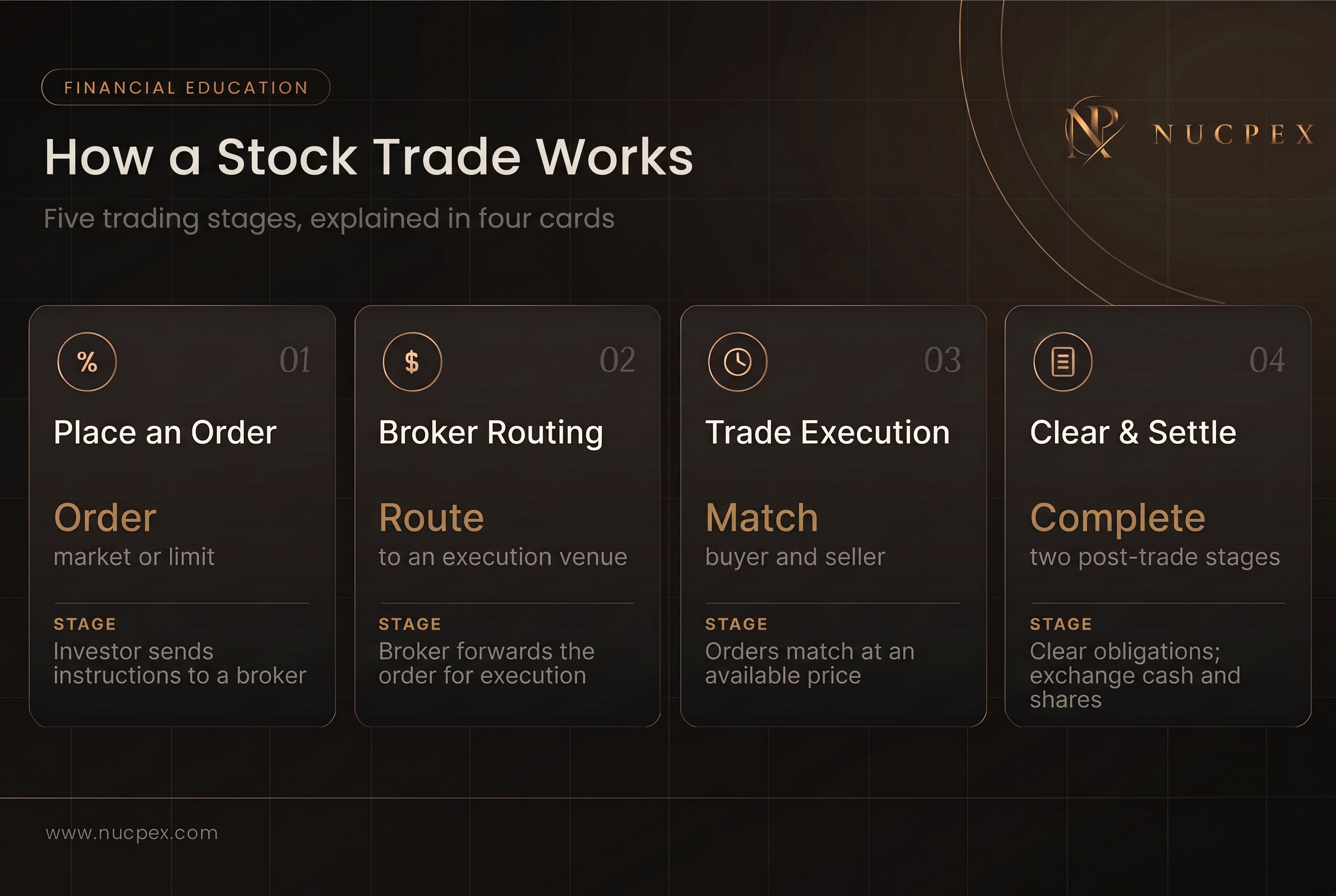
Buying a stock involves more than clicking a button. Your broker processes the instruction, routes it for execution, and arranges the subsequent clearing and settlement process.
Understanding these stages helps explain why displayed prices, executed prices, and available cash balances may differ.
From Order Placement to Settlement
Consider a hypothetical investor buying ten shares at $50 each. If the entire order executes at that price, the purchase costs $500 before any applicable charges.
The process generally follows these stages:
- Order: The investor submits instructions through a brokerage account;
- Routing: The broker sends the order to an appropriate execution venue;
- Execution: A matching transaction occurs at an available price;
- Clearing: Financial obligations are calculated and processed;
- Settlement: Securities and payment are formally exchanged.
For most applicable U.S. stock transactions, settlement follows a T+1 cycle, meaning one business day after the trade date. Other markets may use different schedules.
Market Orders vs. Limit Orders
A market order seeks execution at the best available price, but the final price is not guaranteed. Rapid price movements can make the executed amount different from the quotation initially displayed.
A limit order specifies the maximum price a buyer will pay or the minimum price a seller will accept. It offers price control, but execution is not guaranteed.
The difference between the highest quoted buying price and lowest quoted selling price is called the bid-ask spread. Wider spreads can increase transaction costs.
Why Do Stock Prices Rise and Fall?
Stock prices change because buyers and sellers continuously reassess what companies may be worth. New information affects expectations about future profits, risks, and investment opportunities.
A company can report higher profits while its share price falls if investors expected even stronger results. Conversely, a struggling business may experience a price increase if its outlook improves more than anticipated.
Important influences include:
- Company Performance: Earnings, revenue, debt, and business strategy;
- Interest Rates: Borrowing costs and competing investment returns;
- Economic Conditions: Inflation, employment, and consumer demand;
- Market Sentiment: Expectations, uncertainty, and investor behavior;
- Liquidity: The availability of buyers and sellers at different prices.
A rising stock price therefore does not necessarily mean a company has become more profitable.
Want to know more about stock market indices? Read the article”Major Stock Market Indexes“.
How Do Investors Make Money in the Stock Market?
Investors generally seek returns through share-price appreciation and dividend payments. Neither source of return is guaranteed, and both depend on the company and market conditions.
For example, suppose an investor purchases ten shares at $50 each and later sells them for $60 per share. The initial investment is $500, and the sale proceeds are $600, producing a $100 capital gain before taxes and transaction costs.
If the company also pays a $1 dividend per share during the holding period, the investor receives another $10 before applicable taxes. The combined return would be $110, or 22%, assuming no additional costs.
The opposite is equally important: selling those shares for $40 each would create a $100 capital loss before costs, even if the underlying company remained operational.
What Are Stock Market Indexes?
A stock market index measures the performance of a defined group of securities. Indexes help investors understand market trends without examining every listed company individually.
Different indexes represent different segments of the market. Their movements should not be interpreted as the performance of every stock.
Common examples include:
- S&P 500: Tracks approximately 500 leading U.S. companies;
- Dow Jones Industrial Average: Tracks 30 major U.S. companies;
- Nasdaq Composite: Covers thousands of Nasdaq-listed securities.
Investors cannot purchase an index directly, but certain index funds and exchange-traded funds (ETFs) aim to track its performance.
Main Risks of Stock Market Investing
Stocks offer opportunities for long-term capital growth, but they expose investors to uncertainty. Market downturns can reduce portfolio values, and individual companies can suffer permanent financial damage.
Diversification can reduce dependence on one company or sector, although it cannot eliminate market-wide losses. Investors must also consider investment horizons, liquidity needs, and their capacity to withstand volatility.
How Can Beginners Start Investing in Stocks?
Starting with a clear financial plan is generally more useful than immediately searching for the next popular stock. Investors should understand the instruments they are purchasing and the costs involved.
A practical starting checklist includes:
- Define your financial goals and expected investment horizon;
- Check the broker’s regulatory authorization and account protections;
- Understand commissions, currency conversion costs, and other fees;
- Consider diversification instead of concentrating on one company;
- Review investments periodically without reacting to every headline.
Beginners should distinguish buying actual shares from trading leveraged products such as contracts for difference (CFDs). These instruments involve different rights and risks.
Final Thoughts
Understanding what the stock market is and how it works begins with one central idea: shares represent ownership, while market prices reflect changing expectations about that ownership.
Companies use equity markets to access capital, investors trade existing shares through financial intermediaries, and prices respond to business developments and wider economic conditions.
Learning how orders, costs, returns, and risks interact is an important foundation for informed investing. At NUCPEX, we emphasize financial education, transparent analysis, and investment decisions grounded in individual circumstances rather than market speculation.
Disclaimer: This article provides general financial education and does not constitute personalized investment advice. Investing in stocks involves risk, including possible loss of capital.
Frequently Asked Questions
Can I buy fractional shares instead of whole shares?
Some brokers allow investors to purchase fractions of eligible shares. Availability, voting rights, dividend treatment, and transfer restrictions depend on the broker’s arrangements.
What happens to my shares if my broker goes bankrupt?
The outcome depends on how securities are held and the applicable investor-protection framework. Custody arrangements and compensation schemes vary by jurisdiction.
Can foreign investors buy U.S. stocks?
Many can, subject to broker eligibility rules, local regulations, and applicable restrictions. Currency conversion, withholding taxes, and reporting obligations may apply.
What is a stock split, and does it create wealth?
A stock split increases the number of shares while proportionally reducing the price per share. By itself, it does not change the shareholder’s proportional ownership or create additional company value.
Are stock dividends always paid in cash?
No. Companies may distribute cash dividends or, in some circumstances, additional shares. The available arrangements depend on the company, share class, and corporate actions.

No Comments Yet