
How to Prepare for a Recession: 10 Financial Steps to Protect Your Finances
Economic recessions can affect employment, household income, borrowing costs, and investment portfolios. Although no one can reliably predict exactly when a downturn will begin or how severe it will become, preparing for financial uncertainty can make difficult periods more manageable.
Learning how to prepare for a recession does not require predicting stock market crashes or moving all your investments into cash. It begins with understanding your financial vulnerabilities and taking practical steps to strengthen your position.
This guide covers ten considerations for recession preparation, including emergency savings, debt management, portfolio diversification, and protecting your income.
What Is a Recession?
A recession is a significant decline in economic activity affecting multiple sectors of an economy. It may involve reduced consumer spending, weaker business investment, lower production, and rising unemployment.
Two consecutive quarters of declining real GDP are often described as a recession, but this is a simplified rule. In the United States, the National Bureau of Economic Research evaluates the depth, duration, and breadth of economic weakness using several indicators.
Recessions are a recurring part of economic cycles, but their causes, duration, and consequences vary. Preparing for potential disruption is generally more useful than assuming a particular downturn is inevitable.

10 Important Steps to Prepare for a Recession
Effective recession preparation focuses on financial resilience: maintaining access to essential resources, reducing avoidable obligations, and retaining flexibility when circumstances change.
The following steps can be adapted to different income levels, family responsibilities, and investment objectives.
1. Build an Emergency Fund
An emergency fund provides accessible money for unexpected expenses or temporary income loss. It can reduce the need to borrow at high interest rates or sell investments during unfavorable market conditions.
A commonly used starting target is three to six months of essential living expenses. Households with unstable income, substantial dependents, or limited employment flexibility may need a larger reserve.
For example, if essential expenses total AED 8,000 per month, a six-month reserve would equal AED 48,000.
Keep emergency savings in accessible, appropriately low-risk arrangements, taking account of account terms, currency, and institutional protections.
2. Review Your Monthly Budget
Understanding where your money goes is essential when preparing for possible income disruption. A realistic budget separates unavoidable expenses from spending that can be adjusted.
Review recent bank statements and identify categories that could be reduced without compromising essential needs.
Typical categories include:
- Essential Expenses: Housing, food, utilities, and healthcare;
- Financial Obligations: Loan payments and contractual commitments;
- Adjustable Expenses: Subscriptions, dining, and discretionary shopping.
The goal is to understand how much your household needs to operate if income declines.
3. Reduce High-Interest Debt
Expensive debt can become more difficult to manage when income falls. Credit card balances and high-rate personal loans may consume cash that would otherwise support essential spending.
Prioritize debt according to interest rates, repayment conditions, and the consequences of missed payments. Paying down high-interest balances can reduce future financing costs.
However, using all available savings to repay debt may leave you without emergency liquidity. Balance debt reduction against the need to maintain an accessible cash reserve.
4. Protect Your Employment and Income
A recession can lead businesses to postpone hiring, reduce working hours, or eliminate positions. Employment risk differs across industries and individual circumstances.
Updating professional skills and maintaining an active network can improve flexibility if job conditions change.
Practical actions include:
- Update your résumé and professional portfolio;
- Identify transferable skills and relevant training;
- Maintain professional relationships and industry contacts;
- Review employment contracts and notice-period obligations;
- Explore legitimate supplementary income opportunities.
For UAE residents, employment-related benefits and residency considerations may require additional planning if a job ends.
5. Diversify Your Investment Portfolio
Diversification reduces dependence on the performance of a single company, sector, or asset class. It does not eliminate losses, especially when multiple markets decline together.
A portfolio may contain equities, high-quality bonds, cash equivalents, and other investments depending on an individual’s objectives and risk tolerance.
Review whether your current holdings are concentrated in one industry, country, currency, or employer. Rebalancing should follow a defined investment plan rather than reactions to short-term headlines.
6. Avoid Panic Selling and Market Timing
Financial markets often react to expectations before official economic data confirms a recession. Selling investments after a major decline may lock in losses without guaranteeing an opportunity to repurchase at lower prices.
Investors should distinguish between money needed soon and capital allocated to long-term goals.
If a portfolio’s risk level is no longer appropriate, changes may be justified. However, decisions should reflect liquidity requirements, investment horizons, and portfolio suitability—not fear alone.
7. Maintain Adequate Insurance Coverage
An economic downturn can make unexpected medical, property, or income-related expenses harder to absorb. Insurance helps transfer certain financial risks, subject to policy conditions.
Review coverage limits, exclusions, deductibles, and renewal costs. Consider whether changes in employment could affect employer-provided benefits.
Insurance is not a substitute for emergency savings, but the two can complement each other in a broader financial resilience plan.
8. Delay Unnecessary Major Financial Commitments
Large purchases and new borrowing arrangements can reduce flexibility when future income is uncertain. Long-term contractual obligations deserve particular attention.
Before financing a vehicle, property, or other major purchase, test whether payments would remain affordable after an income reduction.
Avoid assuming that current earnings, bonuses, or investment returns will continue unchanged. Essential purchases may still be necessary, but affordability should be evaluated conservatively.
9. Monitor Economic Indicators Without Overreacting
Economic indicators can provide useful context, but none reliably predicts every recession. Employment trends, inflation, business activity, and consumer spending can send conflicting signals.
The yield curve and financial market volatility also attract attention, although they should not be treated as definitive recession forecasts.
Useful indicators to follow include:
- Employment: Hiring trends and unemployment;
- Economic Output: GDP growth and industrial production;
- Inflation: Changes in consumer prices;
- Interest Rates: Central bank policy and borrowing costs;
- Business Activity: Purchasing managers’ surveys and new orders.
Use these measures to understand economic conditions, not to make impulsive investment decisions.
10. Create a Personal Financial Contingency Plan
A contingency plan turns general concerns into defined actions. It should identify how your household would respond to reduced income, unexpected expenses, or investment losses.
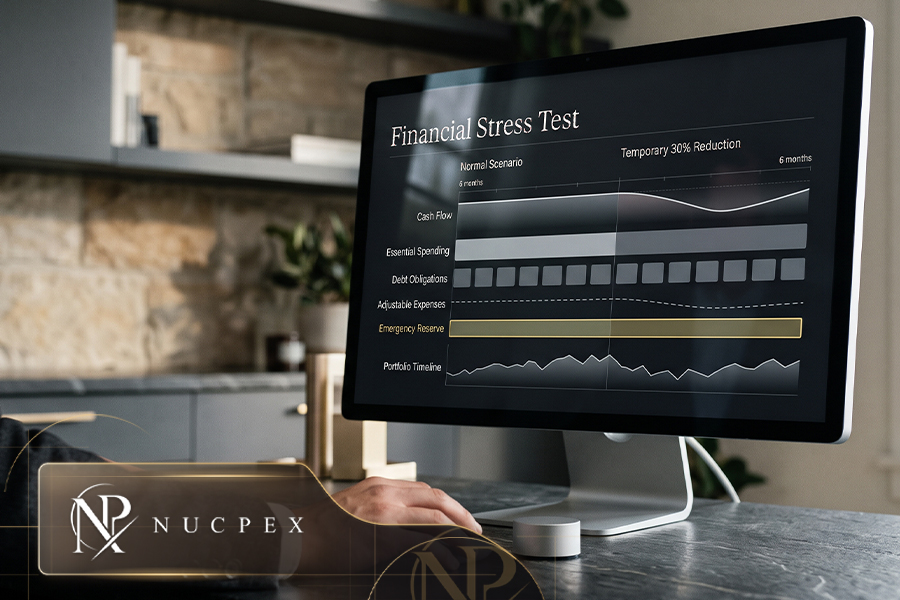
Consider a scenario in which monthly income falls by 30% for six months. Determine which expenses could be reduced, how long your savings would last, and what financial obligations would remain.
Document emergency contacts, account information, essential payment dates, and the steps you would take if circumstances deteriorate.
How Much Emergency Savings Do You Need?
The appropriate emergency reserve depends on essential spending, income stability, dependents, and available support. Three to six months is a common planning benchmark rather than a universal requirement.
Use the following calculation:
Emergency Fund Target = Monthly Essential Expenses × Months of Coverage
These figures are illustrative. Households should adjust their targets for job security, health needs, contractual commitments, and access to other resources.
What Should Investors Consider During a Recession?
Recessions can affect corporate earnings, credit conditions, and asset valuations. However, investment outcomes differ across industries and economic cycles.
A disciplined approach focuses on matching investments to financial goals rather than predicting which asset will perform best during the next downturn.
Investors should review:
- Liquidity Needs: Money required within the next few years;
- Risk Capacity: Ability to absorb losses without financial hardship;
- Asset Allocation: Exposure across investments and currencies;
- Investment Costs: Fees, borrowing expenses, and taxes;
- Time Horizon: When the invested capital will be needed.
Cash and high-quality fixed-income instruments may support stability, but they also carry inflation, interest-rate, or issuer risks. Gold and other defensive assets can fluctuate significantly and are not guaranteed recession hedges.
A 30-Day Recession Preparation Checklist
A short implementation schedule can make recession planning more practical. Rather than attempting every financial change immediately, prioritize the actions that reduce the greatest vulnerabilities.
The following timeline provides a starting framework.
| Timeline | Priority Action |
| Days 1–7 | Calculate essential expenses and review existing savings |
| Days 8–14 | Identify expensive debt and reduce avoidable spending |
| Days 15–21 | Review insurance, employment risks, and investments |
| Days 22–30 | Finalize emergency targets and contingency procedures |
Revisit the plan when income, expenses, employment conditions, or family responsibilities change.
Final Thoughts
Preparing for a recession is primarily about strengthening financial resilience, not predicting the next economic downturn.
Building emergency savings, managing debt, maintaining income flexibility, and reviewing investment risk can improve a household’s ability to respond to uncertainty.
These actions are useful during economic expansions as well as recessions. A realistic financial plan should provide room to adapt without requiring rushed decisions when markets or personal circumstances change.
At NUCPEX, we emphasize transparent financial education, disciplined analysis, and informed decisions aligned with individual circumstances.
Disclaimer: This article provides general financial information and does not constitute personalized investment, legal, or tax advice. Financial products involve risks, and individual circumstances differ.
Frequently Asked Questions
1. How much money should I save before a recession?
A common starting point is three to six months of essential expenses. People with irregular income, dependents, or higher employment uncertainty may consider a larger reserve.
2. Should I sell my stocks before a recession?
Not automatically. Selling based on recession fears can create market-timing risk. Review your investment horizon, liquidity needs, and portfolio allocation before making changes.
3. Is cash the safest investment during a recession?
Cash may offer short-term stability and liquidity, but inflation can reduce purchasing power. Bank and cash-equivalent products also have different institutional and product risks.
4.What happens to debt during a recession?
Debt obligations generally continue even when income declines. Variable interest rates, repayment terms, and the lender's policies determine how borrowing costs and obligations may change.
5. Can you prepare for a recession without a high income?
Yes. Starting with a modest emergency reserve, tracking essential expenses, and reducing costly debt can improve resilience. Consistent, achievable steps are more useful than unrealistic savings targets.



No Comments Yet