
How to Choose a Financial Advisor: 9 Essential Tips

Choosing a financial advisor is an important decision, especially when your savings, future plans, and financial security are involved. You need someone who understands your priorities, explains your options clearly, and helps you make informed decisions without unnecessary pressure.
However, not every financial professional offers the same services or operates under the same regulations. An impressive website, professional title, or attractive investment proposal does not automatically make someone trustworthy.
If you are wondering how to choose a financial advisor, these nine practical tips will help you evaluate potential advisors, recognize warning signs, and make a confident, well-informed decision.
Understand Your Financial Needs
Before comparing financial advisors, identify what you want to achieve. You might need help planning long-term investments, understanding financial markets, preparing for retirement, or evaluating risks across different assets.
Your investment timeline, available capital, liquidity requirements, and tolerance for potential losses will influence the type of professional support you need. Clear priorities also make it easier to determine whether an advisor’s expertise matches your expectations.
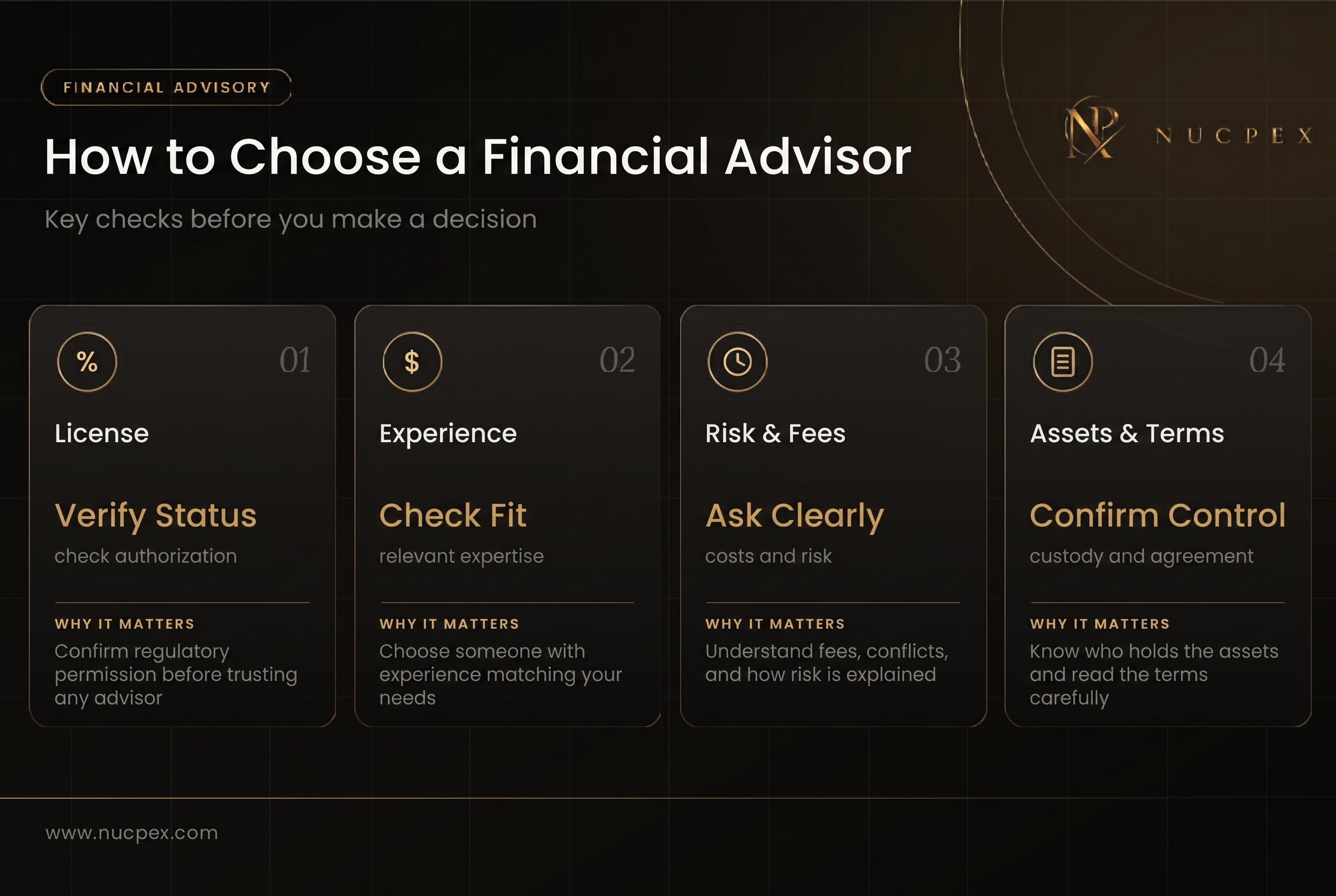
9 Essential Tips for Choosing a Financial Advisor
Finding the right financial advisor requires more than comparing qualifications or listening to investment presentations. You should understand what the professional is authorized to do, how they approach financial decisions, and whether their services suit your circumstances.
The following nine criteria provide a practical framework for evaluating potential advisors.
-
Verify Their License and Regulatory Authorization
A company’s commercial registration does not automatically authorize it to provide every financial service. Investment advice, portfolio management, securities trading, and custody of client assets may require different regulatory permissions.
Ask for the firm’s legal name, regulatory authority, license details, and permitted activities. Verify this information through official sources rather than relying exclusively on marketing materials.
For example, firms regulated within the Dubai International Financial Centre can be checked through the DFSA Public Register. Other firms may operate under different regulatory frameworks.
-
Check Qualifications and Professional Experience
Qualifications help demonstrate financial knowledge, but they should be considered alongside relevant experience. An advisor may understand financial markets without having expertise in your particular circumstances.
Ask about professional certifications, previous experience, areas of specialization, and the types of clients they typically advise. Where possible, verify credentials with the issuing organization.
A professional who understands your financial needs is generally more useful than someone who simply claims expertise across every investment category.
-
Understand Their Legal Responsibilities
Financial professionals do not necessarily have identical obligations toward their clients. Their responsibilities depend on their activities, regulatory status, contractual arrangements, and applicable laws.
Ask whether the advisor must act in your best interests, how conflicts of interest are managed, and which legal standards apply. Terms such as fiduciary have jurisdiction-specific meanings and should not be accepted without clarification.
A reliable advisor should explain these responsibilities clearly and provide relevant documentation when requested.
-
Look for Experience With Similar Clients
Different financial situations require different expertise. A professional specializing in retirement planning may not be the best choice for an entrepreneur managing international financial obligations.
Ask whether the advisor has experience with clients who share similar financial goals, investment horizons, or business circumstances.
You can also request anonymized examples illustrating their advisory approach. These examples should demonstrate their decision-making process rather than promise that previous outcomes will be repeated.
-
Evaluate Their Approach to Investment Risk
A trustworthy financial advisor should discuss potential losses as openly as potential returns. Understanding your financial position and ability to absorb losses should come before recommending investments.
Ask how the advisor evaluates market volatility, liquidity needs, investment horizons, and different economic scenarios.
Be cautious if someone promises consistently high returns while minimizing uncertainty. Even diversified investments can experience losses, and no strategy can guarantee protection against every market condition.
-
Ask for Complete Fee Transparency
An advisor’s compensation can influence their recommendations. Understanding the payment arrangement helps you recognize potential conflicts and compare services fairly.
Request written information about advisory fees, commissions, third-party compensation, and additional charges. Ask which services are included and whether costs can change.
You can explore different pricing arrangements in our detailed article, How Much Does a Financial Advisor Cost?.
-
Clarify Who Controls Your Investments
Receiving financial advice is not the same as giving someone authority to manage your assets. This distinction is particularly important when evaluating firms offering multiple financial services.
Ask where your assets would be held, who can authorize transactions, and whether the advisor has discretionary investment authority.
If an external custodian is involved, verify its identity and regulatory status. Never transfer money to an unexplained account or assume that advisory services require surrendering control of your funds.
-
Assess Communication and Reporting Standards
Financial advice should be understandable. You should feel comfortable asking questions and receiving clear explanations about recommendations, assumptions, and potential risks.
Before engaging an advisor, discuss how frequently you will communicate, what documentation you will receive, and how important changes will be explained.
Professional communication is not simply about providing regular updates. It also means acknowledging uncertainty, explaining limitations, and responding transparently when circumstances change.
-
Compare Multiple Advisors Before Deciding
A positive first impression is not enough to establish a suitable long-term relationship. Comparing different professionals helps you identify meaningful differences in expertise, transparency, and service quality.
When practical, speak with at least two or three advisors. Ask comparable questions and review their responses against your original financial requirements.
Choose based on verified information and professional suitability rather than personality, marketing claims, or promises of exceptional performance.
If you are planning to work with a financial advisor, be sure to read “The Definitive Guide to work with a Financial Advisor“.

Warning Signs to Watch for When Hiring an Advisor
Even experienced investors can overlook warning signs when an investment opportunity appears attractive. Recognizing questionable practices early can help protect your financial interests.
A trustworthy advisor should welcome reasonable questions and allow sufficient time to review important documents. Be particularly cautious about:
- Promises of guaranteed returns without appropriate risk disclosures;
- Pressure to invest immediately or sign agreements without review;
- Unverifiable licenses, qualifications, or performance claims;
- Requests to transfer investment funds to unexplained personal accounts;
- Refusal to disclose compensation arrangements or conflicts of interest.
If important information cannot be independently verified, delay your decision until the concerns are resolved.
Your Financial Advisor Selection Checklist
Once you have shortlisted potential advisors, use a consistent checklist to compare them objectively. This helps prevent an attractive presentation from overshadowing important legal or financial considerations.
Before entering an advisory relationship, confirm that:
- Regulatory permissions cover the services being offered;
- Qualifications and experience match your financial requirements;
- Investment risks and conflicts of interest have been explained;
- Fees, responsibilities, and termination conditions are documented;
- Asset custody and transaction authority are clearly understood.
Keep copies of relevant documents and seek independent clarification whenever contractual terms remain unclear.
Final Thoughts
Understanding how to choose a financial advisor means looking beyond impressive credentials and attractive investment opportunities. Regulatory authorization, relevant experience, transparent communication, and responsible risk management all contribute to a trustworthy professional relationship.
The right advisor should help you understand your financial options without replacing informed judgment with unrealistic promises.
At NUCPEX, we believe sound financial decisions begin with clarity, professional guidance, and a realistic understanding of market risks. If you are considering financial advisory services, contact our team to discuss your needs and learn about our available consulting services.
Frequently Asked Questions
Can I hire a financial advisor from another country?
Potentially, yes. However, cross-border financial advice may be subject to restrictions in both jurisdictions. Verify whether the professional is authorized to serve clients in your location.
Can I change my financial advisor after signing an agreement?
Usually, subject to your contractual terms. Review termination conditions, notice periods, outstanding fees, and any procedures required to transfer documents or accounts.
Should a financial advisor have professional indemnity insurance?
Professional indemnity insurance may provide coverage for certain professional claims. Requirements and coverage vary by jurisdiction, so ask about the policy and its limitations.
Can a financial advisor refuse to accept me as a client?
Yes. Advisors may decline engagements because of regulatory restrictions, conflicts of interest, service limitations, or client eligibility requirements.
What happens if a financial advisory firm closes?
The outcome depends on your contract and how services and assets are arranged. Ask about business continuity procedures, access to records, and applicable client protections before engaging.



No Comments Yet