
How Much Does a Financial Advisor Cost? Understanding Advisory Fees

When you ask the financial services industry a straightforward question—how much does a financial advisor cost?—you usually get an evasive answer.
You hear phrases like “it depends on your goals,” “our fees are competitive,” or “we only take a small percentage.” But that “small percentage” often masks thousands of dollars in annual management costs, underlying fund fees, and lost compounding momentum.
this comprehensive guide pulls back the curtain on advisory costs. We will break down industry benchmarks, examine the mathematics behind each payment model, uncover hidden expenses, and explain how to ensure your advisory fees generate a measurable return.
The Short Answer: Average Financial Advisor Costs at a Glance
In the current wealth management landscape, advisory fees generally fall into five distinct pricing structures:
Assets Under Management (AUM)
Typically costs 0.50% to 1.50% annually (with 1.00% serving as the industry benchmark). This model is best suited for hands-off investors seeking continuous baseline portfolio maintenance.
Flat Annual Retainer
Typically costs $3,000 to $10,000+ per year, billed on a monthly or quarterly schedule via direct transfer. This model works best for business owners and high earners who need predictable, steady baseline planning.
Hourly Consulting Rate
Typically ranges from $200 to $500 per hour, billed strictly for the consultation time used. This structure is ideal for one-off portfolio audits, modular tax questions, or targeted checkups.
Project-Based Fee
Typically costs $2,500 to $7,500 as a one-time fee for a defined deliverable. This is best suited for clients needing a comprehensive financial plan, a business succession roadmap, or an early retirement blueprint.
Profit-Sharing / Performance-Linked
Combines a base operational fee with direct profit participation above an agreed hurdle rate, calculated on realized net compound gains. This structure is designed for high-net-worth investors and wealth partners seeking aligned growth and shared upside.
Looking only at the headline percentage is a mistake. A 1% fee charged on a stagnant portfolio is expensive, whereas a performance-aligned fee on a rapidly compounding balance sheet can be one of the highest-leverage investments you ever make.
How Financial Advisors Charge: The Core Pricing Models
Advisory fees are not one-size-fits-all. Different firms use different billing structures depending on whether their goal is passive wealth maintenance, one-off consulting, or active capital growth.
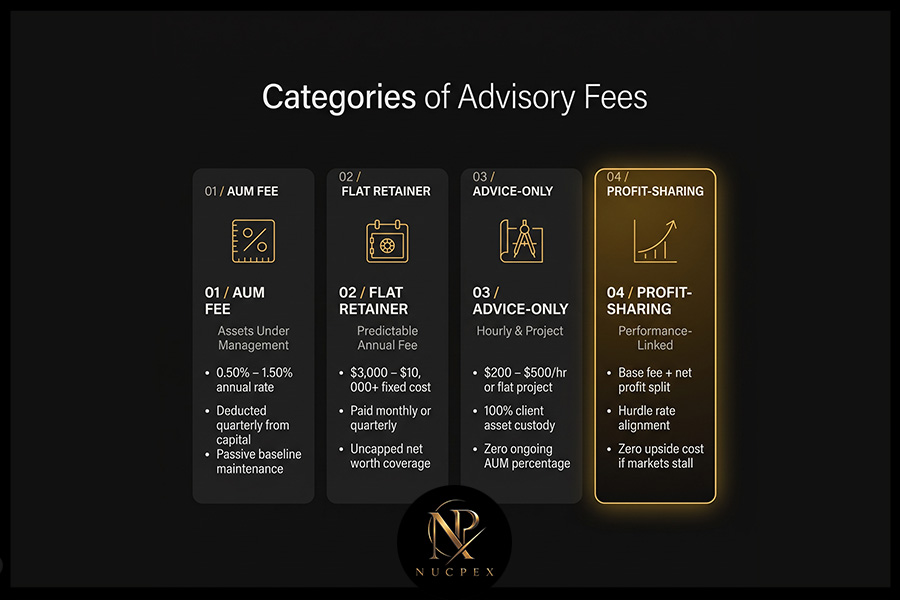
Here is how the four primary models work:
1. Assets Under Management (AUM)
The AUM model is the traditional industry standard. The firm charges a fixed annual percentage of the liquid portfolio they manage for you, deducted directly from your account each quarter.
- Typical Pricing: 0.50% to 1.50% annually, with 1.00% as the benchmark.
- Tiered Sliding Scale: Most firms discount higher balances—charging 1.00% on the first million, 0.75% on the next two million, and 0.50% or less above five million.
- The Drawback: AUM rewards asset gathering over asset performance. An advisor collecting 1% earns their fee whether your portfolio gains 12% or drops 8%. It also discourages you from pulling money out to reinvest in your own business or real estate.
2. Flat Annual Retainer
Instead of billing a percentage of your portfolio, a flat-fee advisor charges a set dollar amount per year, billed monthly or quarterly.
- Typical Pricing: $3,000 to $5,000 annually for straightforward planning; $6,000 to $15,000+ for complex private wealth and business owners.
- The Math: On a $3,000,000 balance sheet, a $7,500 flat fee saves you over $15,000 a year compared to a typical 1% AUM charge.
- The Drawback: Flat fees work well for baseline wealth preservation, but the advisor has no financial incentive to generate outsized returns.
3. Hourly and Project-Based Consulting (Advice-Only)
This structure works like hiring a corporate lawyer or specialized tax accountant. You pay strictly for the time or the specific deliverable.
- Hourly Rates: $200 to $500 per hour for ad-hoc reviews or second opinions.
- Project Fees: $2,500 to $7,500 for a comprehensive financial blueprint or business succession roadmap.
- The Advice-Only Model: The advisor designs your asset allocation and gives you rebalancing steps, but never holds your funds. You execute the trades yourself. It eliminates management percentages, but requires you to handle all the ongoing operational legwork.
4. Performance-Linked Profit-Sharing (The Aligned Growth Model)
The word “commission” means two completely different things depending on where you look:
- Retail Commissions: Brokers and retail banks push annuities, whole life insurance, or loaded mutual funds to pocket upfront cuts (often 3% to 8%+). Their payout happens whether you make money or lose it.
- Private Profit-Sharing (True Alignment): In private wealth management, the advisor charges a base operational fee and takes a percentage of the net compound profits generated above an agreed hurdle rate.
Under a performance-linked model, the advisor has real skin in the game. If the strategy does not beat the agreed baseline, they earn nothing on the upside. When your capital compounds, both sides win.
The Hidden Costs: Calculating Your “All-In” Fee
Looking only at the headline advisory fee covers half the equation. You must calculate the all-in cost of ownership, which includes four cumulative layers:
- Direct Advisory Fee (0.75% to 1.00%): The management fee or retainer paid directly to the firm.
- Fund Expense Ratios (0.05% to 0.85%): Internal fees deducted automatically by ETFs or mutual funds in the portfolio.
- Custody & Platform Fees (0.05% to 0.15%): Administrative and clearing costs charged by the custodian holding your assets.
- Cash Drag & Inflation: Idle cash sitting unallocated in commercial bank accounts loses purchasing power every month. A disciplined advisor eliminates this drag by actively deploying surplus reserves into yield or growth strategies.
- Total Annual Cost: Unmonitored portfolios routinely lose 1.5% to 2.5%+ annually to combined fees and cash drag.
What Real Advisory Fees Should Actually Deliver
If an advisor simply buys three index funds and calls you once a year, any fee is too high. A professional advisory fee should deliver measurable value across three disciplines:
- Risk Profiling & Downside Defense: Setting cash runways (12–24 months of liquidity) and stress-testing your balance sheet so market dips never force you to sell assets at a loss.
- Tax-Smart Structuring: Locating high-yield assets in sheltered vehicles and timing capital gains to minimize annual tax drag.
- Business & Personal Integration: Coordinating corporate cash flow, dividend payouts, and liquidity events with personal wealth growth.
If you want to see how disciplined execution works without retail noise, explore our private financial advisory services at Nucpex. We combine strict downside defense with active execution so your baseline stays safe while pursuing real compound growth.
Learn more: What does a financial advisor actually do?
Final Thoughts
Asking how much a financial advisor costs is only half the question. The real question is: what does that fee deliver in net compounding results?
Paying a passive advisor 1% every year just to hold index funds is a continuous drag on your balance sheet. Paying for disciplined risk management, aggressive downside protection, and a partner whose earnings are tied to your compound gains is an investment that pays for itself.
Have questions about onboarding tiers, cross-border allocations, or partnering with our firm for your clients? Visit our [contact page]!
Frequently Asked Questions
What is the average cost of a financial advisor?
Most traditional firms charge around 1% of assets under management, flat retainers between $3,000 and $10,000, or hourly rates from $200 to $500.
How does a performance-linked or profit-sharing fee work?
The advisor charges a base operational fee and shares in net compound profits generated above an agreed target return, aligning their earnings with your portfolio’s growth.
Are financial advisor fees tax-deductible?
Personal management fees are rarely deductible, but corporate-level advisory fees or specialized business wealth consulting can often be structured efficiently.
How do hidden fees impact long-term compounding?
A 1.5% to 2% all-in fee drag can consume up to 25% of your potential portfolio growth over a twenty-year horizon.
Can an advisor charge both a fixed fee and a performance split?
Yes. Hybrid models use a lower fixed baseline to cover administration alongside a performance split applied only to profits generated beyond a clear hurdle rate.


No Comments Yet