
The Definitive Guide to Working with a Financial Advisor

Managing money sounds simple until life gets real. You start earning more, your taxes get complicated, your business grows, or you begin thinking about retirement. Suddenly, you have dozens of choices to make, and a single bad move can cost you years of hard work.
That is why people hire a financial advisor.
Whether you want to protect your family’s wealth, plan for retirement, or you are a wealth professional looking to partner with trusted advisors to serve your clients and grow your business, this is guide breaks down everything you need to know in plain English.
What Does a Financial Advisor Actually Do?
At its simplest, a financial advisor helps you make smart decisions with your money so you can reach your life goals.
Think of an advisor like a project manager for your financial life. Instead of just picking random stocks, a good advisor connects all the moving parts of your finances into one cohesive plan.
Financial Advisor vs. Financial Planner: What Is the Difference?
People often use these two titles interchangeably, but they focus on different things:
- Financial Advisor: This is a broad umbrella title. It can include investment managers, brokers, insurance agents, or private bankers who help you invest money or buy financial products.
- Financial Planner: This is a specific type of advisor who looks at your whole picture. A financial planning advisor does not just ask, “Where should we invest $50,000?” They ask, “How do your investments, daily cash flow, taxes, insurance, and estate plans work together to help you retire comfortably or pass wealth to your kids?”
Core Services a Financial Advisor Provides
A full-service advisor handles much more than stock trading:
- Retirement Planning: Calculating exactly how much you need to stop working, when to tap into your accounts, and how to make sure you never run out of money.
- Investment Strategy: Building a portfolio of stocks, bonds, and global assets that matches your risk tolerance so you do not panic sell when markets drop.
- Tax Planning: Keeping more of what you earn by locating assets in tax-friendly accounts and timing sales to reduce capital gains.
- Risk and Insurance: Checking your life, disability, and liability coverage to protect your family without selling you expensive policies you do not need.
- Estate and Legacy Planning: Making sure your wills, trusts, and beneficiaries are organized so your assets transfer smoothly to the next generation.
- Business Financial Advice: Helping business owners balance personal wealth with business cash flow, tax strategies, and eventual exit plans.
If you want to see how disciplined capital management works without the usual retail noise, explore our private financial advisory services at Nucpex.
How Financial Advisors Get Paid (And Why It Matters)
How your advisor gets paid directly shapes how they work for you. Always ask how an advisor earns their money before you hand over your capital or sign an agreement.
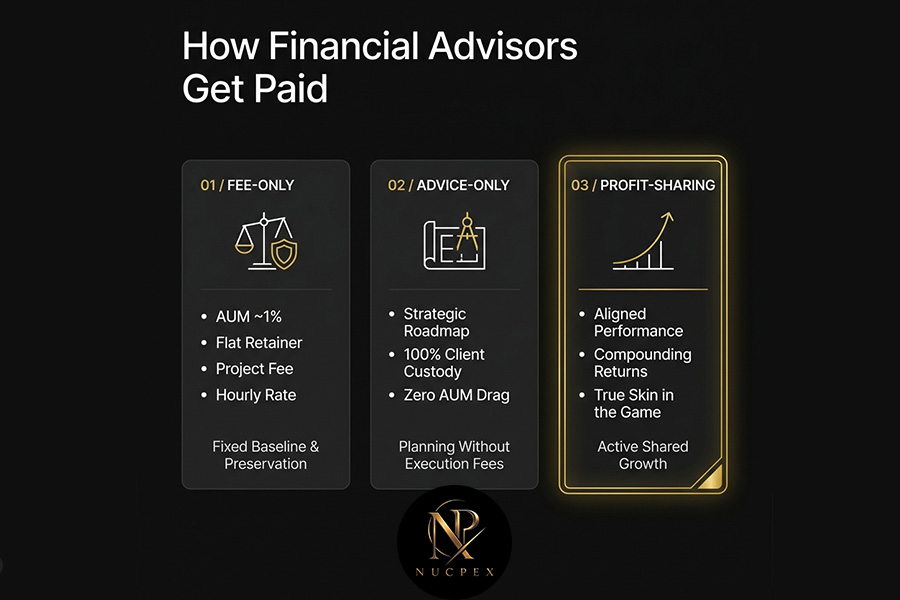
Depending on your financial goals, advisors generally operate under one of these primary payment structures: Fee-Only, Advice-Only and Commission & Profit-Sharing Models. Before you decide to work with a financial advisor, it’s better you read article “How Much Does a Financial Advisor Cost? Understanding Advisory Fees“.
When working with an active private wealth advisor, the best deal for true alignment is through performance-linked commissions.
In private capital management and specialized advisory, commission structures often work as profit participation. The advisor’s earnings depend directly on growing your portfolio, giving both sides real skin in the game: your advisor only thrives when your capital actively compounds.
How to Pick the Right Advisor: 4 Practical Steps
if you’re willing to trust someone with your finances, you should be smart about it! this a complete step-by-step guide to make sure you find the right financial advisory services:
1. Know What You Want Before You Call
Don’t start interviewing advisors with a blank sheet of paper. Decide what problem you are paying to solve:
- Are you looking for a steady retirement income strategy?
- Do you want an active growth partner for your capital?
- Or do you need a trusted advisory partner to co-manage client wealth alongside your existing business?
2. Don’t Get Obsessed with Geography
Typing “financial advisor near me” into a search bar is fine if you insist on drinking coffee in someone’s office every quarter. But local doesn’t mean qualified.
Today’s best firms operate globally. Finding a team that understands your tax jurisdiction, wealth profile, and specific market appetite matters far more than whether their office is five miles down the road.
3. Review Their Professional Footprint on LinkedIn
LinkedIn is one of the most transparent tools for evaluating an advisor’s real background. Read what they publish. Do they demonstrate a sharp understanding of macroeconomics, market risk, and capital preservation, or are they just reposting generic motivational quotes?
4. Request an Official Track Record Statement
Never take claims about performance or strategy on faith alone. Ask the firm for an official, documented statement detailing:
- Verified Performance History: Ask for audited returns or documented case studies showing how their strategies have performed across different market cycles.
- Corporate Registration and Legal Standing: Ensure the advisory firm is properly incorporated and operating under a legitimate corporate entity.
- Clear Terms in Black and White: Any performance-sharing, commission structure, or management fee must be clearly stated in an official engagement agreement before you move a single dollar.
5. Ask Direct Questions
Treat the discovery call like an interview. Watch how clearly they answer:
- How exactly does your firm earn money from my account?
- What is my total annual cost, including underlying fund expense ratios and custody fees?
- Where will my capital be held?
- How do you measure success for your clients?
If they dodge questions about fees, guarantee market-beating returns with “zero downside,” or rush you to sign documents on day one, walk away.
You can request a private consultation with Nucpex to review your liquidity targets, risk limits, and portfolio allocation before committing your full balance.
Final Thoughts
Choosing an advisor ultimately comes down to alignment: do you want someone who charges a passive fee just to hold your hand, or do you want an active growth partner who only succeeds when your capital compounds? Building and protecting substantial wealth is never a solo project, especially when you run a business, manage corporate cash flow, or guide high-net-worth clients across different markets. Focus on transparency over salesmanship, demand written statements of past performance, and partner with an advisory firm whose financial incentives directly match your ambition.
Have immediate questions about onboarding tiers, cross-border allocations, or partnering with our firm for your own clients? Visit our contact page for a confidential discussion.
Frequently Asked Questions
What is the main difference between fee-only and profit-sharing advisors?
Fee-only advisors charge a fixed fee regardless of returns, while profit-sharing advisors tie their compensation directly to compounding your capital above an agreed target.
How much wealth do I need before hiring a financial advisor?
You need one once your balance sheet develops complexity—such as running a business, managing cross-border assets, or approaching retirement where costly mistakes hurt.
How do lawyers, accountants, and consultants benefit from an advisory partnership?
Partnering with an active wealth firm lets you provide institutional-grade capital management to your high-net-worth clients, strengthening retention and expanding your business.
How do I verify an advisor’s track record and credibility?
Review the team’s executive background on LinkedIn, request an official statement of strategy performance, and verify all profit-sharing terms in a written agreement.


No Comments Yet