
What Does a Financial Advisor Do? Roles, Responsibilities & Scope

So, what does a financial advisor do? Think of them as the executive manager for your entire balance sheet. Instead of staring at trading screens or pushing retail financial products, a real advisor spends their day setting strict risk limits, actively rebalancing your portfolio against inflation and market drift, reducing tax drag, and connecting your personal wealth with your business cash flow. In short, their job is to protect your baseline capital, keep you from making costly mistakes, and ensure every dollar has a clear strategy behind it.
What Does a Financial Advisor Bring to the Table?
A real advisory relationship is not an awkward annual meeting where someone reads you a confusing pie chart. It is an ongoing, active partnership built on mutual transparency and shared incentives.
In a healthy advisory relationship, the dynamic is simple:
- What you bring to the table: Total clarity on your financial reality—your cash-flow needs, upcoming business plans, tax obligations, and honest liquidity boundaries.
- What the advisor delivers: Emotional detachment, disciplined execution, and continuous risk management. When market headlines create panic, your advisor acts as the rational filter that keeps you from pulling the trigger on impulsive, costly moves.
Instead of an adversarial relationship where a broker pushes products to hit an internal sales quota, a true wealth partnership sits on the same side of the table. When compensation is tied to compounding your capital rather than collecting passive fees, the relationship shifts from a one-off transaction into a long-term alliance focused entirely on your balance sheet’s growth.

Let’s go over what a financial advisor actually does:
1. Risk Profiling: Setting Guardrails Before Touching a Dollar
Most people say they have a high risk tolerance until markets drop 15% and they can’t sleep at night. A primary job of an advisor is to separate how you feel about risk from what your balance sheet can actually survive.
Before deploying any capital, an advisor maps out your financial boundaries:
- Your Cash Runway: Locking down how much liquid cash you need over the next 12 to 24 months. If your living expenses and business cash flow are covered, you will never be forced to sell investments at a loss during a market dip.
- Downside Stress-Testing: Modeling what happens to your net worth if global markets drop 20%, interest rates spike, or currency rates swing. You should know your worst-case numbers before they happen, not after.
- Debt and Liability Checks: Looking at your business loans, mortgages, and personal liabilities to ensure an unexpected market shock doesn’t put your core assets at risk.
Capital growth is the goal, but capital preservation always comes first.
2. Daily Portfolio Monitoring: Fighting Drift and Cash Drag
Investing is not a “set-and-forget” project. Markets move every day, economic cycles turn, and unmonitored accounts slowly lose their edge.
Behind the scenes, an advisor manages two silent portfolio killers:
- Portfolio Drift: When one sector or asset class runs hot, it quietly expands to take over a dangerous percentage of your net worth. Without disciplined rebalancing, a balanced portfolio can turn into an aggressive gamble without you realizing it. An advisor trims winning positions and reallocates capital to keep your risk in check.
- Cash Drag: Leaving large sums of cash sitting in low-yield bank accounts feels safe, but inflation quietly eats away at your purchasing power every month. An advisor keeps capital moving—putting surplus liquidity into structured yield or growth assets so every dollar is working.
- Active Market Adjustments: Central bank interest rates change, inflation prints swing, and global trade shifts. Rather than sitting passively through major market disruptions, an active advisor makes calculated moves to shield your baseline and capture compounding upside.
If you want to see how disciplined execution works without the usual retail noise, explore our [private client framework at Nucpex].
3. Tax-Smart Structuring: Keeping What You Earn
Making a 12% return on an investment means very little if unexpected taxes take a third of it back. A major part of an advisor’s value is structuring your assets so you don’t bleed money to tax drag.
This comes down to three practical moves:
- Asset Location: Putting dividend-heavy or actively traded assets into tax-sheltered accounts, while keeping long-term growth investments in vehicles with favorable capital gains treatment. Where you hold an asset matters just as much as what you buy.
- Strategic Timing on Gains: Timing when you sell positions so you can balance gains against losses, avoiding ugly surprises when tax season arrives.
- Cross-Border & Corporate Alignment: If you run a business or hold assets across different countries, an advisor ensures money moving between your corporate entities and personal accounts doesn’t trigger double taxation or compliance headaches.
4. Big-Picture Planning: Connecting Money to Real Life
Investment returns are useless if they don’t serve your actual life and business goals. An advisor steps back from daily market noise to look at how the puzzle pieces fit together:
- Retirement & Cash-Flow Sequencing: Figuring out the exact order in which you should draw down accounts in retirement so you minimize taxes and ensure your money outlives you.
- Business Exits & Liquidity Events: For founders and business owners, personal wealth is usually tangled up in company equity. An advisor helps separate your family’s security from company risk, plan dividend payouts, and structure your finances ahead of a sale or succession.
When to Step In: Clear Signs You Need an Advisor
Managing your own money works fine when your finances are simple. But as your income climbs and your balance sheet expands, self-managing often turns into second-guessing.
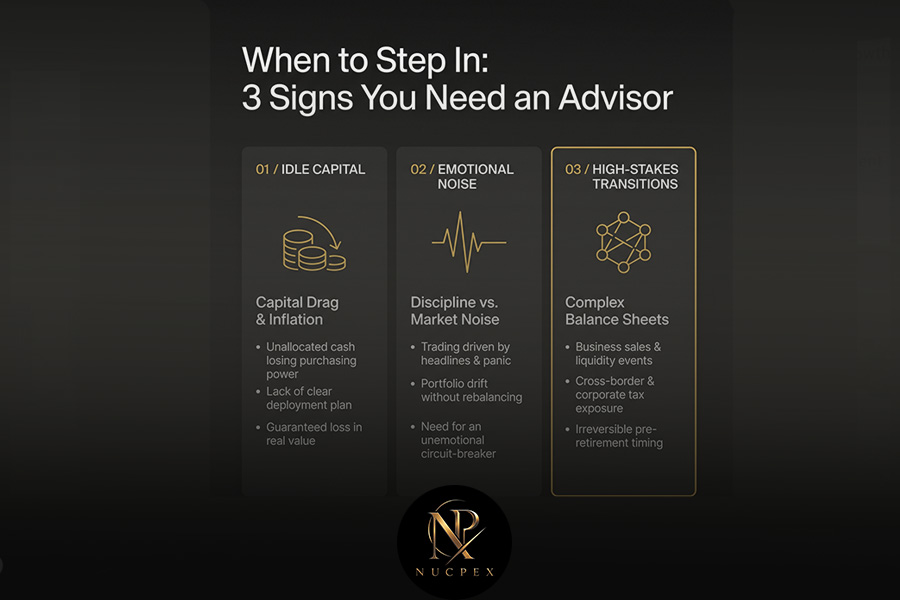
Here are three clear signals that your capital has outgrown a DIY approach:
1. Idle Capital Is Losing the Race Against Inflation
Keeping large sums of unallocated cash in standard commercial bank accounts feels safe, but it is a guaranteed loss in purchasing power every single year. If your capital is sitting stagnant because you don’t have a clear strategy or the bandwidth to deploy it, cash drag is actively eating away at your net worth. Just as Investopedia says, an advisor puts that idle money to work across risk-managed, income-producing, and growth assets tailored to your horizon.
2. Market Noise Is Driving Emotional Decisions
If a bad headline makes you want to sell everything, or market hype tempts you into chasing high-risk bets, emotion has replaced discipline. Portfolios without objective oversight suffer from drift, erratic trading, and costly mistiming. An advisor steps in as an unemotional circuit-breaker—rebalancing your assets according to math and risk thresholds rather than fear or greed.
3. High-Stakes Milestones Have Complicated Your Balance Sheet
Routine finances are easy to handle; major transitions are not. Selling a company, handling a sudden liquidity event, restructuring international assets, or stepping into the final five years before retirement are irreversible moments. A single tax blunder or poor distribution sequence can erase years of compounding. An advisor connects the legal, tax, and investment dots so your long-term security remains intact while your life changes.
If your balance sheet is showing any of these friction points, do not wait for a costly market swing or tax mistake to force your hand. You can request a private consultation with Nucpex.
Final Thoughts
A financial advisor’s job is not about predicting tomorrow’s headlines or picking the next trending stock. It is about applying consistent, unemotional discipline to your balance sheet. By managing risk before chasing returns, keeping tax drag to a minimum, and actively monitoring portfolios against inflation, an advisor ensures your capital works as hard as you do. When hiring an advisor or choosing a wealth partner for your clients, look past titles: focus on operational transparency, verifiable track records, and a compensation structure that aligns their daily effort with your compounding success.
Have questions about onboarding tiers, partner collaboration, or international allocations? Visit our [contact page] for a direct, confidential discussion.
Frequently Asked Questions
What does a financial advisor do on a daily basis?
They monitor portfolio balances, adjust asset allocations, manage tax exposure, assess downside risk, and coordinate long-term planning with outside legal and tax experts.
Is a financial advisor the same as an investment manager?
An investment manager focuses strictly on buying and selling securities, while a comprehensive advisor coordinates your entire balance sheet, including taxes, retirement, and business assets.
How does an advisor protect capital during market downturns?
Advisors set strict liquidity reserves, diversify across non-correlated global assets, and use disciplined rebalancing rules to prevent emotional selling during volatility.
How do I know if an advisor is actively managing my money?
Active advisors provide detailed monthly reporting, communicate allocation adjustments during market shifts, and tie their success directly to transparent performance milestones.


No Comments Yet